Quick Answer: What Is Sodium Formate?
Sodium formate is a water-soluble organic salt with the chemical formula HCOONa, CAS No. 141-53-7, and a molecular weight of approximately 68.01 g/mol. Also known as sodium methanoate, it is used in solid deicing, oilfield drilling fluids, leather tanning, textile processing, and chemical manufacturing.
For B2B buyers, the right sodium formate is determined by more than purity. Production route, moisture, organic impurities, chloride limits, particle size, physical form, packaging, and delivered cost can all affect product performance and procurement risk.
For current grades, technical specifications, and bulk supply options, visit HOO CHEMTEC’s Sodium Formate Product Page.
1. Key Chemical Properties and Specifications
Sodium formate is typically supplied as a white powder, crystal, or granular solid. The required specification should always be linked to the final application rather than selected only by the lowest quoted price.
| Property | Buyer Relevance |
|---|---|
| Chemical name and formula | Sodium Formate / Sodium Methanoate / HCOONa |
| CAS No. | 141-53-7 |
| Molecular weight | 68.01 g/mol |
| Active assay | Defines the usable sodium formate content and commercial grade |
| Moisture content | Affects storage stability, free flow, caking risk, and shipped net weight |
| Organic impurities | Important for color-sensitive leather, textile, and chemical applications |
| Chloride content | Important for corrosion-sensitive infrastructure and chloride-controlled systems |
| Appearance | Helps assess grade consistency, contamination risk, and impurity profile |
| Particle size | Affects dissolution, dust generation, spreading behavior, and dosing |
| Bulk density | Relevant for container loading, packaging, and automated feeding systems |
A general industrial grade may be sold at different assay levels, such as 90%, 95%, 97%, 98%, or 99%. However, buyers should request a batch-specific Certificate of Analysis, not rely only on a generic website specification.
For example, higher assay alone does not guarantee suitability. A deicing contractor may prioritize granular size, low dust, moisture resistance, and chloride control. A leather or textile buyer may prioritize color, organic impurity limits, and clean dissolution.
Buyer Tip: State minimum assay, maximum moisture, required particle size, and any impurity limits directly in the purchase contract.
Request Current Sodium Formate Specifications and CoA →
2. Powder vs. Granular Sodium Formate
The correct physical form depends on how the product will be dissolved, handled, stored, and applied.
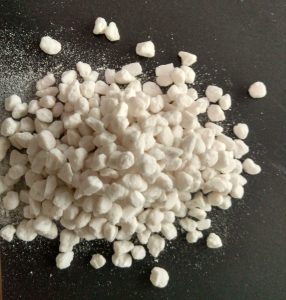
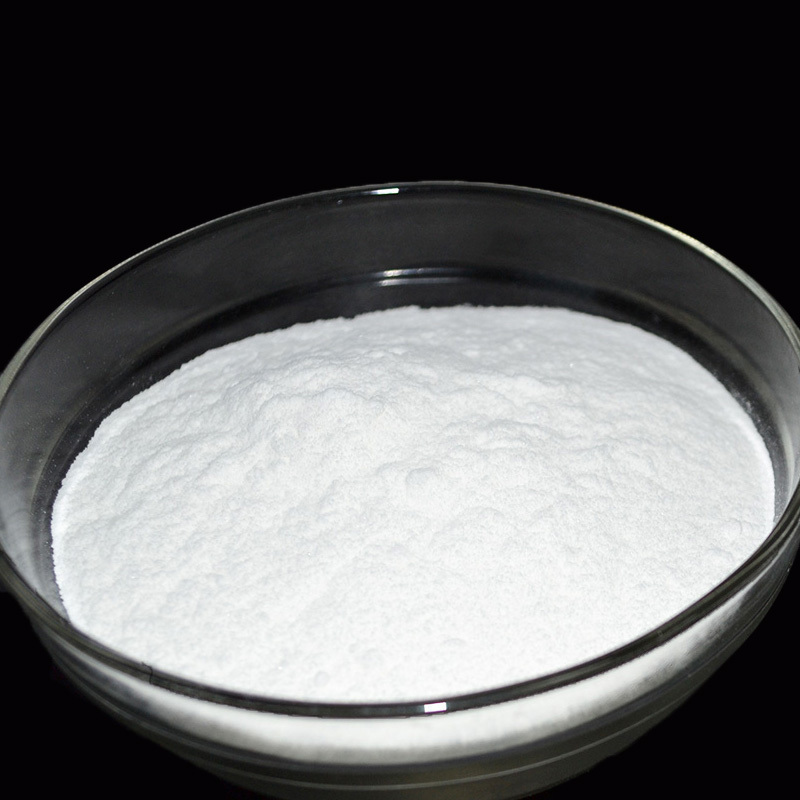
| Requirement | Powder Grade | Granular Grade |
|---|---|---|
| Dissolution speed | Usually preferred for rapid dissolution and fine blending | Depends on granule size and mixing conditions |
| Dust level | Higher dust potential during handling | Typically lower dust and better free flow |
| Suitable applications | Leather, textiles, chemical blending, liquid formulations | Solid deicing, mechanical spreading, bulk handling |
| Storage sensitivity | Requires careful moisture control | Often easier to handle in hoppers and spreaders |
| Equipment compatibility | Suitable for mixing tanks and controlled dosing | Suitable for spreading equipment and automated feeding |
Choose powder when rapid dissolution, homogeneous blending, or precise addition to a liquid system is important.
Choose granules when low dust, mechanical spreading, free flow, and easier warehouse handling are the priority. This is especially relevant for airport, bridge, parking-deck, and infrastructure deicing programs.
HOO CHEMTEC’s existing Sodium Formate page distinguishes powder and granular products for different industrial and deicing handling requirements.
Compare Powder and Granular Sodium Formate Options →
3. Manufacturing Routes: Synthetic vs. By-Product
Commercial sodium formate can be manufactured through direct chemical synthesis or recovered as a by-product from another industrial process.
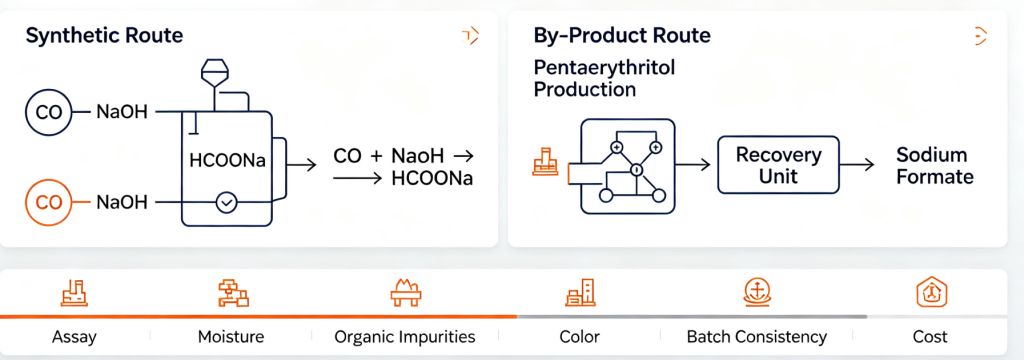
One established synthesis route is the reaction between carbon monoxide and sodium hydroxide:
Sodium formate may also be recovered as a by-product from pentaerythritol production. The production route can influence assay, moisture, organic impurities, color, batch consistency, and cost.
Synthetic Sodium Formate
Synthetic grade is generally selected when buyers need tighter impurity control, more consistent appearance, higher assay, and predictable batch-to-batch performance.
It may be appropriate for:
- Premium deicing formulations
- Color-sensitive leather and textile processes
- Higher-specification chemical formulations
- Selected drilling-fluid applications
- Processes requiring controlled moisture or impurity limits
By-Product Sodium Formate
By-product grade can be a cost-effective choice where the application allows broader impurity limits, possible color variation, or less demanding performance requirements.
It may be suitable for:
- General industrial use
- Selected deicing applications
- Non-sensitive chemical processing
- Some drilling-fluid and oilfield applicationsPurchasing Rule: The best sodium formate grade is not always the highest-purity grade. It is the lowest-risk grade that consistently meets your process, quality, handling, documentation, and total-cost requirements.
Check Available Sodium Formate Grades →
4. Major Industrial Uses of Sodium Formate
Sodium formate is used across several industries because it is available as a stable solid, dissolves in water, and provides a formate source for industrial systems.
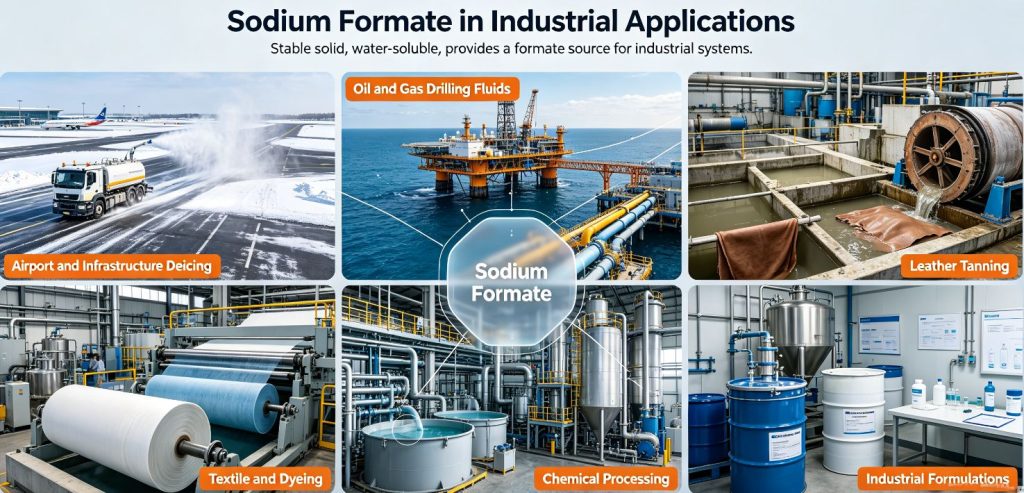
| Application | Typical Function | Recommended Buying Focus |
|---|---|---|
| Airport and infrastructure deicing | Solid deicer or anti-icing formulation component | Particle size, moisture, chloride limits, spreading performance |
| Oil and gas drilling fluids | Formate-brine component for selected fluid systems | Solubility, purity, fluid compatibility, clarity |
| Leather tanning | Process auxiliary in selected tanning operations | Color, impurity profile, dissolution quality |
| Textile and dyeing | Processing or formulation auxiliary | Clean dissolution, consistency, color control |
| Chemical processing | Raw material or intermediate | Assay, moisture, impurity control |
| Industrial formulations | Selected additive or buffering component | Compatibility with the final formulation |
Sodium formate should be selected based on the actual process requirements. It is not automatically interchangeable with potassium formate, sodium acetate, calcium chloride, or magnesium chloride.
Explore HOO CHEMTEC Deicing Chemicals →
5. Sodium Formate for Deicing and Anti-Icing
Sodium formate is used as a formate-based solid deicer for selected airport, runway, bridge, parking-deck, and concrete-infrastructure applications.
The product earns widespread consideration for projects requiring reduced chloride exposure or low-chloride, chloride-regulated deicing formulations per technical specifications. However, buyers should not assume that every sodium formate product meets every airport or corrosion-control standard. Product selection must be verified through the relevant CoA, technical specification, project requirement, and local regulation.
Questions to Ask Before Buying Sodium Formate Deicer
- What is the expected operating temperature range?
- Is the product for deicing, anti-icing, or both?
- Is the surface concrete, asphalt, metal, or aviation pavement?
- Does the project require granules for mechanical spreading?
- Are chloride limits stated in the contract or maintenance specification?
- Is low dust important for worker safety and application efficiency?
- Are test reports, environmental documents, or third-party inspection required?
HOO CHEMTEC positions Sodium Formate within its deicing range for corrosion-sensitive surfaces, including airports, bridges, parking areas, and concrete pavements.
Request a Sodium Formate Deicing Grade Recommendation →
6. Sodium Formate in Oil and Gas Drilling Fluids
Sodium formate can be dissolved to prepare formate brines for selected drilling, drill-in, completion, and workover-fluid systems. Formate salts are valued in some oilfield applications because they can support clear-brine systems with controlled density and low solids.
Sodium, potassium, and cesium formates are all used in oilfield fluid technologies, but they are not interchangeable. The appropriate formate salt depends on the required brine density, fluid design, temperature profile, chloride restrictions, formation conditions, and cost target.
| Buyer Requirement | Why It Matters |
|---|---|
| Required brine density | Determines whether sodium formate alone is suitable |
| Application stage | Drilling, completion, workover, and drill-in fluids may require different controls |
| Solids and clarity requirement | Important for clear-brine or low-solids fluid systems |
| Chloride limitation | May affect selection of formate-based alternatives |
| Dissolution requirement | Determines suitable particle size and form |
| Fluid compatibility | Sodium formate must match the complete fluid program |
| Documentation | CoA, SDS, testing method, and inspection may be required |
For oilfield buyers, a quotation request should include the target fluid density, intended application, required quantity, delivery location, and any required impurity limits.
Discuss Your Sodium Formate Drilling-Fluid Requirement →
7. Sodium Formate vs. Alternative Deicers
Deicing chemical selection should be based on total applied cost, material compatibility, operating conditions, chloride requirements, handling method, and project specifications.
| Chemical | Typical Form | Chloride Status | Typical Selection Consideration |
|---|---|---|---|
| Sodium Formate | Powder or granules | Formate-based; confirm chloride specification by CoA | Solid deicing for selected corrosion-sensitive projects |
| Potassium Formate | Liquid or solid | Formate-based; confirm specification by CoA | Liquid anti-icing and higher-density formate-brine applications |
| Sodium Acetate | Solid or liquid | Typically chloride-free formulation option | Airport and infrastructure deicing alternatives |
| Sodium Chloride | Solid or brine | Contains chloride | Standard road deicing where cost is a primary factor |
| Calcium Chloride | Flake, pellet, or liquid | Contains chloride | Common winter maintenance and lower-temperature deicing |
| Magnesium Chloride | Flake, pellet, or liquid | Contains chloride | Road deicing and dust-control applications |
Buyers prioritizing low dust, formate-based chemistry, minimal chloride exposure, or corrosion-prone surfaces can select sodium formate for solid deicing applications. Potassium formate delivers superior performance for liquid anti-icing systems and high-density brine formulations.
Learn About Potassium Formate →
8. How to Select the Right Sodium Formate Grade
Use this four-step framework to select the right product.
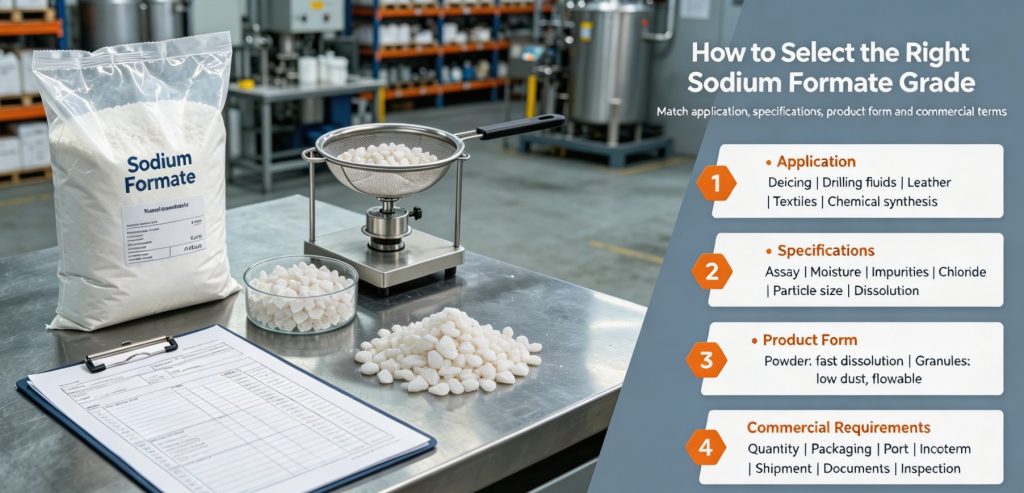
Step 1: Define the Application
Indicate the application of sodium formate: deicing, drilling fluids, leather tanning, textile processing, chemical synthesis, or general industrial manufacturing.
Step 2: Define Critical Specifications
Identify the parameters that matter most:
- Minimum assay
- Maximum moisture
- Organic impurity tolerance
- Chloride limit
- Required appearance
- Particle-size range
- Dissolution speed
- Packaging and storage requirement
Step 3: Select Product Form
Choose powder for rapid dissolution and fine blending. Choose granules for lower dust, better flowability, and solid spreading equipment.
Step 4: Confirm Commercial Requirements
Your RFQ should include:
- Required grade and specification
- Powder or granular form
- Order quantity
- Bag size and pallet requirement
- Destination port
- Incoterm
- Target shipment date
- Required documents
- Inspection standard
Get a Sodium Formate Grade Recommendation →
9. Sodium Formate Price: Cost Drivers and Landed Cost
Evaluate sodium formate based on total delivered cost rather than the basic FOB price per metric ton.
| Cost Driver | Impact on Price |
|---|---|
| Production route | Synthetic and by-product grades can have different cost structures |
| Assay and impurity limits | Higher purity or tighter limits may increase production and QC cost |
| Product form | Granulation, screening, and dust-control requirements may affect cost |
| Packaging | PE lining, palletization, jumbo bags, and custom labels add cost |
| Order quantity | Full-container and contract volumes may improve unit logistics efficiency |
| Destination | Freight, duty, port charges, and inland delivery vary by country |
| Inspection | Third-party inspection and special certificates may add cost |
Avoid comparing quotations that use different Incoterms or different specifications. A lower product price may not mean a lower delivered cost.
Request FOB or CIF Sodium Formate Pricing →
10. How to Evaluate a Sodium Formate Supplier
Buyers evaluate a supplier’s reliability based on product consistency, documentation, export performance, and after-sales service, rather than focusing solely on price.
Supplier Pre-Order Checklist
- Confirm whether the offer is synthetic grade, by-product grade, or another defined grade.
- Request a current TDS and batch-specific CoA.
- Confirm assay, moisture, impurity limits, appearance, and particle size.
- Ask about quality testing, batch traceability, and retained samples.
- Confirm packaging details, including inner liner, palletization, and moisture protection.
- Check whether SDS, Invoice, Packing List, CoA, and other export documents are available.
- Confirm third-party inspection options before loading.
- Define the claims process for quality, shortage, damage, or moisture-related issues.
- Compare quotations using the same grade, packing, quantity, and Incoterm.
HOO CHEMTEC’s existing product page identifies support for product documentation, export packaging, CoA, SDS, and customized packing options. Buyers should request current documents for the specific grade and order.
Request Current Documents and Bulk Supply Details →
11. Storage, Packaging and Common Purchasing Issues
Storage
Sodium formate can absorb moisture from air. Store it in a cool, dry, well-ventilated warehouse, keep packaging sealed, and avoid placing bags directly on damp floors. Opened bags should be resealed promptly.
Common Issue: Caking
Cause: High moisture, poor inner-liner sealing, damaged packaging, or humid storage.
Prevention: Specify moisture limits, use moisture-resistant packaging, maintain dry storage, and inspect container loading before shipment.
Common Issue: Purity Mismatch
Cause: Confusion between synthetic and by-product grades, unclear purchase specifications, or dependence on generic product data.
Prevention: State the minimum assay and maximum moisture in the contract. Require a batch-specific CoA and define the inspection method.
Common Issue: Dissolution Residue or Off-Color Product
Cause: Particle-size mismatch, impurities, unsuitable grade, or material contamination.
Prevention: Confirm the intended process, request a representative sample when needed, and specify color and impurity requirements for sensitive applications.
Request Sodium Formate CoA and Bulk Quote
HOO CHEMTEC supports industrial buyers sourcing Sodium Formate for deicing, drilling fluids, leather, textiles, and chemical processing.
To receive a practical quotation and grade recommendation, please provide:
- Application
- Required grade or assay
- Powder or granular form
- Quantity
- Packaging requirement
- Destination port
- Preferred Incoterm
- Required documents
- Target delivery date
Request Sodium Formate CoA, TDS, SDS or Bulk Quote →