In the volatile 2026 chemical market, Sodium Silicate (widely known as Water Glass or Liquid Glass,) remains an indispensable “invisible” foundation for global infrastructure and manufacturing. From green detergent formulations to high-performance concrete densifiers, understanding the synergy between its chemical modulus and market pricing is critical for procurement efficiency.
What is Sodium Silicate? (The Comprehensive Guide to Water Glass)
Sodium silicate is an inorganic compound composed of sodium oxide (Na₂O) and silicon dioxide (SiO₂). It is typically supplied in the form of a liquid solution or a solid glassy material, and is widely used as a binder, adhesive, and chemical additive in industries such as construction, detergents, and water treatment.
In global B2B trade, buyers typically distinguish between two primary states:

- Liquid Sodium Silicate: Clear to cloudy aqueous solutions varying in viscosity and density (Baume).
- Solid Sodium Silicate (Cullet): Glassy, lump-form crystals preferred for long-distance export to minimize shipping weight and costs.
- Liquid vs. Solid: Available as high-viscosity aqueous solutions or as cullet (glassy lumps) that require high pressure to dissolve.
Quick Technical Specs:
CAS Number: 1344-09-8.
Physical Nature: Highly water-soluble and exhibits strong alkalinity.
Primary Function: Acts as a powerful inorganic binder and pH buffer
Key Properties and Chemical Mechanism: How It Work
Understanding the chemical mechanism of water glass is essential for optimizing its industrial performance. The versatility of sodium silicate stems from its unique transition between liquid, gel, and solid states.
1. Chemical Reactivity & Stability
Sodium silicate exhibits exceptional stability in alkaline and neutral environments. However, its core reactivity is triggered by pH shifts:
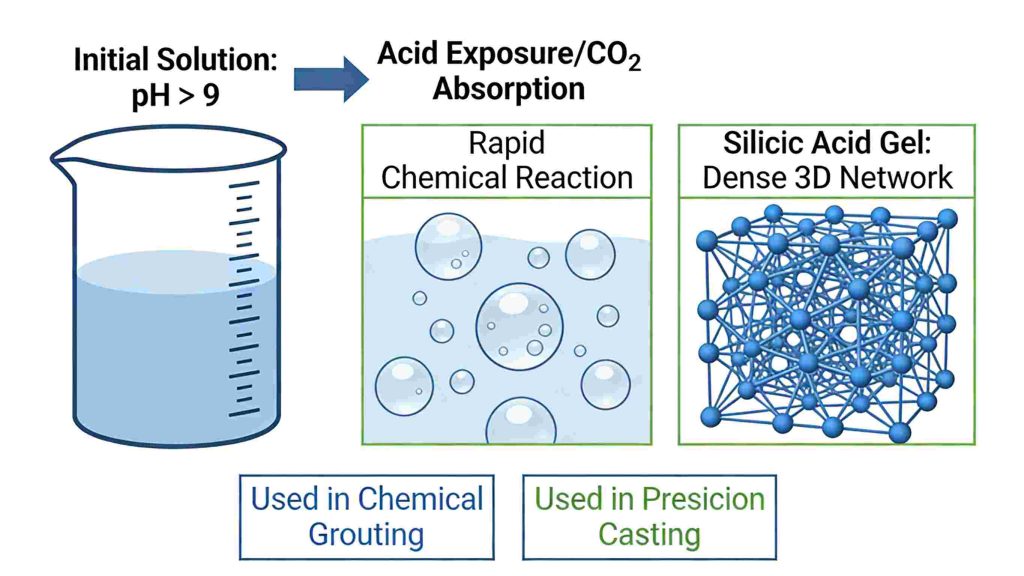
- Silicic Acid Gel Formation: When the pH drops below 9 (due to acid exposure or CO2 absorption), a rapid chemical reaction occurs. This triggers the formation of a silicic acid gel, a dense, three-dimensional network that serves as the foundation for chemical grouting and precision casting.
- pH of Sodium Silicate: Typically maintaining a high alkalinity (pH 11–13.5), it acts as a powerful buffer.
2. Physical States & Thermal Transformation
To accommodate diverse industrial needs, sodium silicate is manufactured in three primary forms:
- Liquid (Aqueous): The most common commercial form, defined by its Baumé (density) and viscosity.
- Glassy Solid (Cullet): The raw, lump form with low solubility of water glass in cold water, requiring high-pressure steam to dissolve.
The "Glass-Like Seal": At elevated temperatures or upon complete dehydration, sodium silicate undergoes a physical transition to form a glass-like seal. This film is non-combustible, providing superior heat resistance and structural reinforcement in automotive and construction sectors.
3. Functional Performance Metrics
The industrial utility of sodium silicate is driven by four technical behaviors:
- Superior Adhesion: It functions as an elite inorganic binder, creating high-strength ionic bonds with mineral surfaces, paper fibers, and metal oxides.
- Advanced Film-Forming: Upon drying, it creates a continuous, chemically resistant barrier. This property is critical for dust-proofing concrete and protecting surfaces from oxidative corrosion.
- Ion Exchange & Heavy Metal Removal: In water treatment, the silicate structure facilitates ion exchange, effectively sequestering heavy metal cations and acting as a cost-effective coagulant aid.
- Controlled Gelation Behavior: The “set time” of sodium silicate can be precisely engineered. By adjusting the modulus and adding catalysts, the gelation behavior can range from near-instant (for tunnel leak sealing) to delayed (for foundry mold casting).
Technical Comparison: Selecting the Right Sodium Silicate Grade
In industrial procurement, selecting between physical forms and chemical ratios can significantly impact your Total Cost of Ownership (TCO). Use the tables below to match your operational requirements.
1. Physical Form Comparison: Liquid vs. Solid Cullet
Choosing the right state is primarily a balance between logistical costs and immediate usability.
| Feature | Liquid Sodium Silicate (Aqueous) | Solid Sodium Silicate (Cullet) |
| Purity & Clarity | High; filtered for immediate use. | High; requires dissolution. |
| Solubility | Instantaneous mixing. | Low; requires high-pressure autoclaves. |
| Logistics | Higher weight due to water content. | Lower freight costs (ideal for export). |
| Storage | Requires IBC tanks or drums. | Can be stored in bulk silos or bags. |
| Primary Use | Regional manufacturing, detergents. | Long-distance global sourcing. |
2. The “Modulus” Matrix: Low vs. High Molar Ratio
The sodium silicate modulus ratio (SiO2/Na2O) determines the chemical behavior of the product.
| Specification | Low Modulus (Alkaline) | High Modulus (Neutral) |
| Molar Ratio | 1.6 – 2.5 | 2.6 – 3.4+ |
| pH Level | High Alkalinity (pH 13+) | Near Neutral/Lower Alkalinity |
| Setting Speed | Slower; remains liquid longer. | Rapid gelation and fast set time. |
| Bonding Strength | Moderate. | Superior; forms rigid glass-like film. |
| Best For | Heavy-duty degreasers, textile scouring. | Construction, paper bonding, foundries. |
3. Industrial Grade Sodium Silicate Selection Guide
Based on 2026 industrial standards, here is the recommended configuration for key sectors:
| Industrial Grade | Physical Form | Target Modulus | Core Function |
| Detergent Grade | Liquid/Powder | 2.0 – 2.4 | Buffering & metal protection. |
| Construction Grade | Liquid | 3.0 – 3.3 | Concrete densifying & waterproofing. |
| Water Treatment | Liquid | 3.2 – 3.4 | Lead/copper corrosion inhibition. |
| Adhesive Grade | Liquid | 2.8 – 3.2 | High-speed paper tube winding. |
Major Industrial Applications (Industry Breakdown)
Sodium silicate is an “invisible” essential in modern industry:
- Detergents & Cleaning: Acts as a builder to soften water and prevents dirt from redepositing on fabrics.
- Construction & Cement: Functions as a concrete densifier, waterproofing agent, and soil stabilizer for infrastructure projects.
- Water Treatment: Used as a coagulant aid and for effective heavy metal removal.
- Oil & Gas: Crucial as a drilling fluid additive and for well sealing/water shutoff operations.
- Adhesives & Binders: Used extensively in paper/cardboard bonding and as a high-temperature refractory binder.
- Specialized Sectors: Includes engine gasket sealants in automotive repair, deflocculants in ceramics, and dust control in agriculture
Sodium Silicate Market & Demand Insights
The global demand for sodium silicate remains robust, driven by the expansion of the green detergent and sustainable construction sectors.
- Detergents: Remain the largest consumer segment globally.
- Construction & Water Treatment: Emerging markets are seeing increased adoption due to the cost-effectiveness of silicate-based soil and water solutions.
Sodium Silicate Buying Guide: Sourcing from Hoochemtec
Selecting the right supplier is as critical as selecting the right grade. Hoochemtec provides tailored silicate solutions designed for maximum industrial efficiency.
1. How to Choose the Right Grade
- Modulus Selection: Match the SiO2:Na2O ratio to your specific application (e.g., higher for binding, lower for cleaning).
- Solid Content & Viscosity: Ensure the concentration matches your processing equipment’s requirements.
2. Packaging & Logistics
We offer flexible options including standard Drums, IBC Totes, and Bulk shipments to accommodate various storage capabilities.
3. Pricing Factors
- Raw Materials: Prices are influenced by the cost of silica sand and soda ash.
- Customization: Specific modulus requirements can impact production costs.
- Transportation: We optimize shipping routes to manage total landed costs effectively.
Optimize Your 2026 Chemical Procurement
Looking for high-purity Sodium Silicate with reliable lead times? Hoochemtec combines technical expertise with a robust global supply chain to deliver the exact grade your industry demands.
FAQs
Q: Is sodium silicate hazardous?
A: It is non-flammable and non-toxic to the environment. However, due to its high alkalinity, it is classified as a skin and eye irritant. Always refer to the MSDS provided by Hoochemtec.
Q: How does the price fluctuate?
A: Pricing is primarily driven by the cost of Soda Ash (energy-intensive) and Silica Sand (logistics-dependent).
Q: Can I dissolve solid sodium silicate myself?
A: Yes, but it requires specialized pressure vessels (autoclaves) and steam, as it does not dissolve easily in cold water at atmospheric pressure.