
Choosing PBTCA for an industrial water treatment system is not simply a matter of finding the lowest price or the highest stated concentration. For buyers, the real question is whether the product has consistent quality and fits the requirements of the treatment program. A supplier’s product name may look the same as another supplier’s, but the detailed specification can tell a different story.
This is why buyers should look beyond the headline figures when comparing PBTCA suppliers. A clear understanding of the product specification can help you compare quotations more accurately, reduce quality risks, and avoid unexpected differences between batches.
In this guide, we will walk through the key PBTCA specifications buyers should review before placing an order, and explain how TDS and COA documents can support a better purchasing decision.
Why PBTCA Specifications Matter When Buying for Industrial Water Treatment
Two PBTCA products may both claim 50% active content, but that does not mean they have the same quality or will perform the same way in an industrial water treatment program. Active content is only one part of a PBTCA specification. Buyers should also check pH, density, phosphorous acid, phosphoric acid, chloride, iron, appearance, and batch consistency before making a purchasing decision.
For example, common industrial PBTCA specifications include a minimum active content of 50%, a pH of 1.5–2.0 in a 1% water solution, and a density of at least 1.27 g/cm³. Limits for phosphorous acid, phosphoric acid, iron, and chloride also appear in technical specifications from multiple suppliers.
These numbers give buyers a useful starting point, but they should not be treated as universal requirements. Specifications can vary between suppliers and product grades. When comparing PBTCA suppliers, always check the supplier’s TDS (Technical Data Sheet) and the COA (Certificate of Analysis) for the actual batch. More importantly, confirm that the agreed specification matches your water treatment application.
In the following sections, we will look at each key PBTCA specification and explain what buyers should check before placing a bulk order.
Check the Active Content of PBTCA First
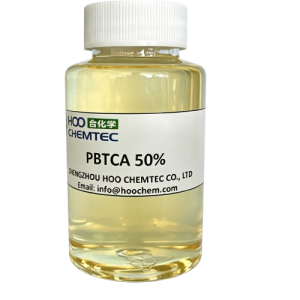
Once you understand why the full specification matters, the first figure to check is active PBTCA content. Many industrial-grade PBTCA products are supplied at around 50% active content. HOO CHEMTEC specifies 50% minimum active content for its PBTCA product, which is in line with common industrial specifications.
However, buyers should look at more than the number “50%” on a product sheet.
What should buyers check?
- Active PBTCA content: Check the guaranteed minimum value and compare it with the typical value, if provided.
- Testing method: Ask the supplier how the active content is determined. This helps ensure that you are comparing products on the same basis.
- Guaranteed minimum: A specification such as 50% min sets the minimum level the supplier commits to meeting.
- Typical value: If the supplier provides a typical batch result, compare it with the guaranteed specification.
- Batch-to-batch consistency: A stable product specification is important for customers who use PBTCA in regular production or formulated water treatment programs.
A 50% PBTCA product is generally an aqueous solution rather than 50% pure solid material. Technical data sheets from different suppliers commonly specify active content around 49–51% or 50% minimum.
Compare Cost per Unit of Active Ingredient
Price per metric ton can be misleading when comparing PBTCA suppliers. Instead of looking only at the quoted price, buyers should consider how much active PBTCA they actually receive.
For example, if two products have different active concentrations, the lower price per ton does not automatically mean the lower cost for your treatment program. Comparing the cost per unit of active ingredient gives a more useful picture of the actual purchasing value.
This approach also makes it easier to compare quotations from different PBTCA manufacturers and select a product based on both specification and cost.
Why pH Is an Important PBTCA Specification
After checking the active content, the next specification buyers should review is pH. It may look like a simple number on a PBTCA technical data sheet, but the test conditions matter just as much as the result.
PBTCA is supplied as an acidic aqueous solution, so its pH provides useful information when buyers compare products and review batch quality. However, buyers should avoid comparing pH values without checking how the supplier measured them.
What should buyers check?
- Test concentration: Confirm whether the supplier reports pH for a 1% water solution or under another condition.
- Specified range: Check the supplier’s guaranteed pH range rather than relying on a general industry value.
- Testing conditions: Use the same concentration and test conditions when comparing different PBTCA suppliers.
- Batch consistency: Compare the pH shown on the COA with the agreed specification to see whether the actual batch meets the required range.
For example, HOO CHEMTEC lists pH (1% water solution) at 1.5–2.0 for one PBTCA specification. Other published industrial PBTCA specifications also use a 1% water solution and report the same 1.5–2.0 range.
This does not mean that every PBTCA product must have exactly the same pH specification. Different grades and suppliers may use different specifications. For buyers, the key is to compare like with like and confirm the test method before evaluating a quotation.
When reviewing a PBTCA technical data sheet, therefore, do not simply ask, “What is the pH?” Ask, “How was the pH measured, and does the actual batch meet the agreed specification?” This gives you a more reliable basis for supplier comparison and quality control.
Check Density When Comparing Different PBTCA Suppliers
After reviewing active content and pH, buyers should also look at PBTCA density. Density is often overlooked because it does not directly describe scale inhibition performance. However, it can help buyers check whether a product matches the agreed specification and compare products from different suppliers on the same basis.
For industrial-grade PBTCA, a common specification is density at 20°C of at least 1.27 g/cm³. Several published PBTCA specifications use this value, although some suppliers may provide a specific range instead.
What should buyers check?
- Test temperature: Density changes with temperature, so confirm that suppliers use the same reference temperature, such as 20°C.
- Unit: Check whether the result appears in g/cm³, kg/L, or another unit.
- Minimum or typical value: A specification may give a minimum limit or a typical range. Do not treat these values as the same.
- Consistency with active content: Compare density with the active content and other product specifications instead of judging density alone.
- Actual batch result: When possible, compare the density on the COA with the agreed product specification.
For buyers, the key point is simple: higher density does not automatically mean better PBTCA. Instead, density works as one part of a broader quality check. When comparing a PBTCA supplier, review density together with active content, pH, impurity limits, and batch data.
This gives you a more complete picture before moving on to the next quality factor: impurity control.
Pay Attention to Phosphorous Acid and Phosphoric Acid Content
Active content tells you how much PBTCA is present, but it does not tell the whole quality story. Buyers should also check the limits for phosphorous acid and phosphoric acid on the PBTCA specification sheet.
These compounds can appear as controlled components or impurities in commercial PBTCA products. For example, several published industrial specifications set phosphorous acid at 0.5% maximum and phosphoric acid at 0.2% maximum.
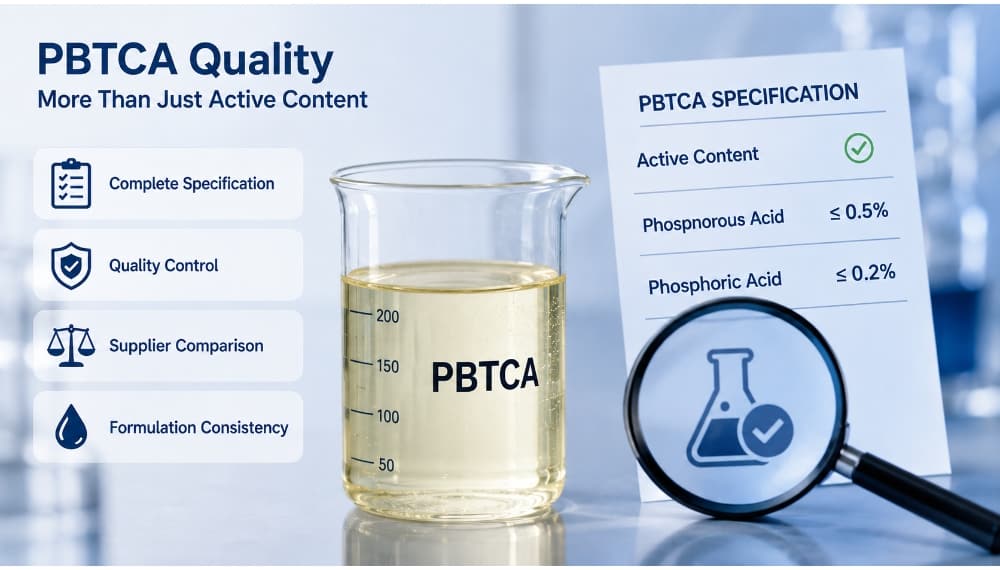
Why should buyers check these values?
- They complete the product specification: Active content alone cannot describe every component in a PBTCA solution.
- They help with quality control: Defined impurity limits give buyers clear criteria for checking incoming batches.
- They support supplier comparison: Two products with similar active content may have different impurity specifications.
- They matter in formulated programs: When PBTCA becomes part of a larger water treatment formulation, consistent raw material quality can make formulation control easier.
However, buyers should not assume that “lower is always better.” The more useful question is whether the product consistently meets the specification required for your application.
Specification limits can vary between suppliers and product grades, so always confirm the agreed values before ordering. Check both the supplier’s PBTCA technical specification and the COA for the actual batch.
For procurement teams, this is an important shift in thinking: PBTCA quality is not just about concentration. It is also about controlled and consistent composition.
Check Iron and Chloride Levels Before Bulk Purchase
Before placing a bulk PBTCA order, buyers should take one more look at the impurity profile, especially iron (Fe) and chloride. These values often appear in ppm rather than percentage, so they are easy to overlook when reviewing a technical data sheet.
Common industrial PBTCA specifications may set both iron and chloride at 10 ppm maximum. HOO CHEMTEC’s published PBTCA specification also lists Fe at 10 ppm max and chloride at 10 ppm max.
What should buyers look for?
- Iron content: Check the maximum Fe level and confirm the unit, usually ppm or mg/L.
- Chloride content: Check the maximum chloride level and how the supplier reports it.
- COA results: Do not rely only on the product specification. Ask for the COA of the actual production batch.
- Specification consistency: Compare the COA results with the limits agreed in the purchase specification.
- Application requirements: If your water treatment formulation has strict raw material requirements, confirm the acceptable impurity levels before placing a large order.
These checks become especially useful when you move from a sample order to regular supply. A supplier may meet the basic active-content requirement, but buyers still need confidence in batch-to-batch consistency.
For this reason, don’t evaluate a PBTCA supplier only by active content and price. A more useful evaluation combines active content + impurity limits + physical properties + batch consistency. Reviewing these factors before a bulk purchase can help you compare suppliers more accurately and reduce the risk of receiving material that does not match your treatment program.
Ask for a COA Before Placing a Bulk PBTCA Order
After reviewing the main PBTCA specifications, the next step is to turn those numbers into a practical purchasing check. Before placing a bulk order, buyers should ask for product documents that confirm both the supplier’s standard and the quality of the actual material they plan to receive.
At a minimum, request:
- COA (Certificate of Analysis)
- TDS (Technical Data Sheet)
- SDS (Safety Data Sheet)
- Detailed product specification
- Batch number
- Manufacturing date
- Test date
- Packaging information
The TDS or agreed product specification shows the quality requirements the supplier commits to meeting. The COA, on the other hand, should show the test results for a specific production batch. Chemical quality documentation commonly uses batch-specific information such as batch number and test results to verify that the material meets the stated specification.
For this reason, buyers should compare the two documents side by side. Check whether the active content, pH, density, and impurity levels on the actual batch COA meet the agreed limits.
Also review the batch number and dates carefully, especially for repeat or large-volume orders. Clear packaging information helps you confirm the net weight, packaging type, and shipment requirements before production or loading.
A quotation alone cannot provide the full quality picture. For a bulk PBTCA order, the combination of an agreed specification and a batch-specific COA gives buyers a much stronger basis for quality control. This is especially important when moving from sample testing to long-term supply.
Match PBTCA Specifications With Your Water Treatment Application
By this point, buyers have reviewed the main quality indicators and product documents. The next question is more important: Does this PBTCA match the actual water treatment application?
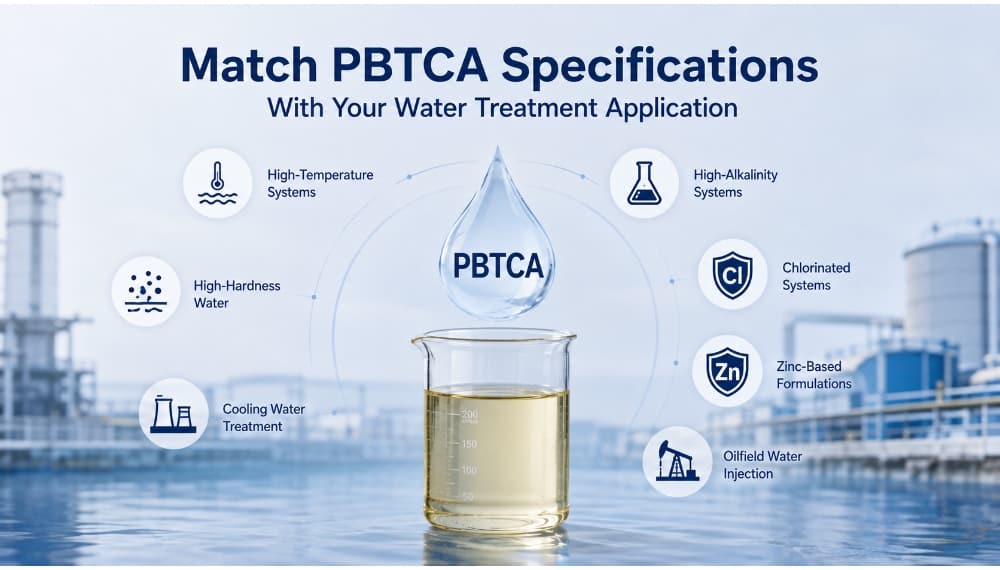
When evaluating a PBTCA product, buyers should focus on the factors that matter most to their specific system:
| Application | What Buyers Should Focus On |
| Cooling water treatment | Scale and corrosion inhibition performance, formulation compatibility |
| High-hardness water | Scale inhibition performance under high calcium and mineral content |
| High-temperature systems | Thermal performance and stability at operating temperatures |
| High-alkalinity systems | Performance under alkaline water conditions and overall formulation compatibility |
| Chlorinated systems | Oxidation and chlorine tolerance |
| Zinc-based formulations | Zinc stabilization and compatibility with other treatment chemicals |
| Oilfield water injection | Scale and corrosion control under the specific water conditions |
Before making a bulk purchase, share relevant water conditions and treatment requirements with your PBTCA supplier. This can help you compare products based on application needs rather than specifications alone. A suitable product specification should support the performance your system actually requires.
Final Checklist: How to Choose the Right PBTCA
After reviewing the product specifications and your application requirements, the final step is to compare everything before placing an order. A good PBTCA purchasing decision should consider both product quality and supplier capability.
Before buying PBTCA, check:
- Active content and the guaranteed specification
- pH and test conditions
- Density and measurement temperature
- Phosphorous acid and phosphoric acid limits
- Iron and chloride levels
- COA, TDS, and SDS availability
- Compatibility with your water treatment application
- Batch-to-batch consistency
- Packaging options and shipment requirements
- MOQ and lead time
- Supplier manufacturing and quality control capability
This checklist helps buyers move beyond a simple price comparison. Common PBTCA specifications include active content, pH, density, and limits for phosphorous acid, phosphoric acid, iron, and chloride, but the final requirements should always match the agreed specification and your treatment program.
In short, the right PBTCA is not simply the cheapest product or the one with the best-looking specification. It is the product that consistently meets your quality requirements and supports your water treatment system.
Why Choose HOO CHEMTEC for PBTCA?
Choosing a PBTCA supplier is easier when the key purchasing requirements are clear. HOO CHEMTEC provides PBTCA specifications that address the quality indicators discussed in this guide, including active content, physical properties, impurity limits, and batch documentation.
HOO CHEMTEC PBTCA specifications include:
- Active Content: 50% MIN
- Appearance: Clear, colorless to light yellow liquid
- pH: 1.5–2.0 (1% water solution)
- Density: ≥1.270 g/cm³ at 20°C
- Phosphorous Acid: ≤0.5%
- Phosphoric Acid: ≤0.2%
- Fe: ≤10 ppm
- Chloride: ≤10 ppm
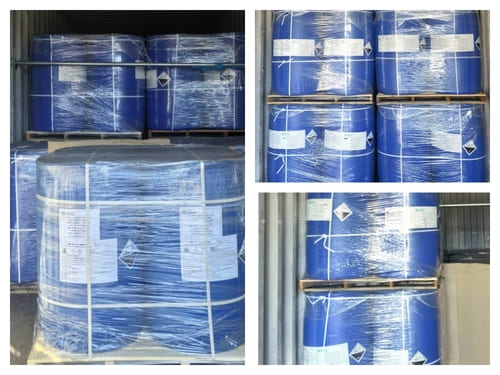
We also provide TDS, SDS, and batch-specific COA to support product evaluation and quality control. Standard packaging includes 250 kg drums, with bulk supply options available for larger orders. PBTCA is suitable for industrial cooling water treatment and other scale and corrosion control applications.
If you are comparing PBTCA suppliers, you can share your required specifications and application conditions with HOO CHEMTEC to discuss the right product for your treatment program.
Conclusion
Choosing the right PBTCA for industrial water treatment requires more than comparing prices or checking the active content. Buyers should review the complete product specification, including pH, density, impurity limits, and batch consistency. TDS, SDS, and a batch-specific COA can also provide important information before a bulk order.
At the same time, product specifications should match the actual water treatment program. Factors such as water hardness, operating temperature, alkalinity, and formulation requirements can all affect the purchasing decision.
The best approach is to compare suppliers using the same technical requirements and evaluate both product quality and supply capability. By checking the specification carefully and confirming the actual batch data, buyers can make a more informed PBTCA purchasing decision and build a more reliable long-term supply relationship.
FAQ
What specifications should I check when buying PBTCA?
You should check active PBTCA content, pH, density, phosphorous acid, phosphoric acid, iron, chloride, appearance, and batch consistency. You should also request the TDS, SDS, and a COA for the actual production batch.
Is 50% active content enough to judge PBTCA quality?
No. Active content is an important specification, but it does not show the complete quality profile. Buyers should also compare physical properties, impurity limits, test methods, and batch consistency before making a purchasing decision.
Why should I ask for a COA before placing a bulk PBTCA order?
A COA shows the test results for a specific production batch. Buyers can compare these results with the agreed product specification to confirm that the actual material meets the required limits.
How do I compare different PBTCA suppliers?
Compare suppliers using the same requirements, including product specifications, batch COA results, documentation, packaging, MOQ, lead time, and supply capability. Avoid comparing quotations based on price alone.