
Introduction
Aluminum chloride (AlCl₃) can serve as a primary coagulant in water treatment, but its performance depends heavily on raw water alkalinity, pH, and mixing conditions. In waters with sufficient buffering capacity and proper pH control, AlCl₃ hydrolyzes to form aluminum hydroxide flocs that remove suspended particles. Low-alkalinity water requires additional alkalinity to prevent excessive pH depression and maintain suitable coagulation conditions. If the process is not properly controlled, residual dissolved aluminum may also become a concern. Jar testing determines dosage, as there is no universal dose.
This guide provides a technical and commercial evaluation framework for water treatment engineers and B2B procurement professionals. It covers coagulation mechanisms, key water quality variables, testing methods, application scenarios, and comparisons with polyaluminum chloride (PAC) and aluminum sulfate (alum).
Key Takeaways
- AlCl₃ hydrolysis produces a range of dissolved and precipitated aluminum species. Positively charged hydrolyzed species destabilize particles and neutralize charge.
- Aluminum chloride (AlCl₃) is acidic, consuming alkalinity and lowering pH. The actual alkalinity demand depends on raw water buffering, dosage, and hydrolysis pathway, verified through testing.
- The optimum pH range depends on raw water quality and treatment objectives. Operators cannot assume it from a fixed range; they should establish typical operating windows by jar testing.
- Engineers should not treat AlCl₃ as a direct substitute for PAC. The two products differ in chemical form, alkalinity demand, and sludge characteristics.
- Jar testing is the standard practical method for screening and optimizing coagulant dosage, with pilot testing and online monitoring providing additional validation.
How Does Aluminum Chloride Work in Water Treatment?
Aluminum chloride dissociates rapidly in water, undergoing hydrolysis to form dissolved and precipitated aluminum species. The distribution of these species—monomeric aluminum, polymeric aluminum, and amorphous Al(OH)₃ precipitate—depends strongly on pH, temperature, and ionic strength.
Primary coagulation mechanisms include:
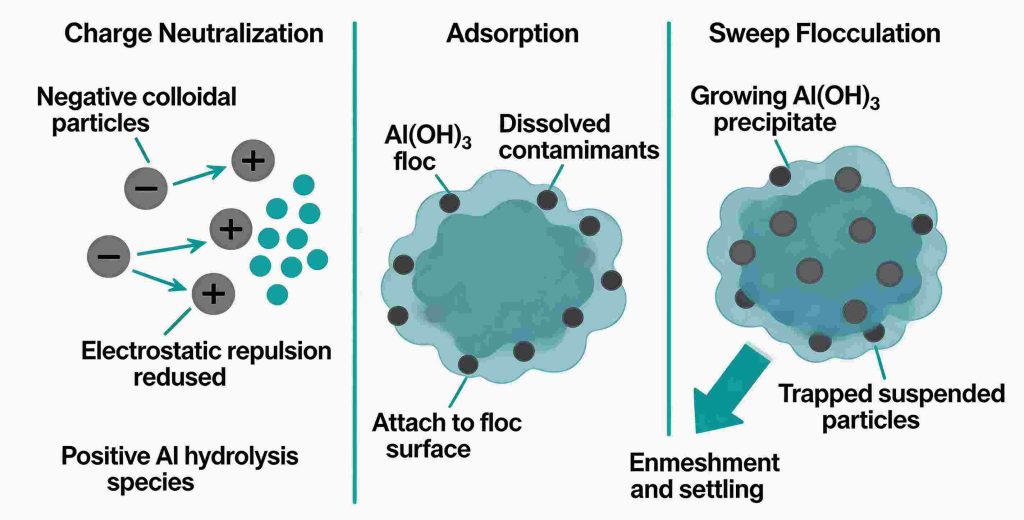
- Charge neutralization: Positively charged hydrolyzed aluminum species adsorb onto negatively charged particles, reducing electrostatic repulsion.
- Adsorption: Dissolved contaminants attach to the surface of aluminum hydroxide flocs.
- Sweep flocculation: Under favorable conditions, the precipitation of amorphous Al(OH)₃ enmeshes suspended particles and carries them out of suspension.
The relative contribution of each mechanism varies with pH, dose, and mixing intensity. Hydrolysis is rapid and sensitive to water chemistry, making coagulation performance unpredictable from stoichiometry alone.
What Factors Affect Aluminum Chloride Coagulation Performance?
Raw water and process variables influence AlCl₃ performance as a coagulant:
- pH: Determines which aluminum species predominate and directly affects coagulation efficiency.
- Alkalinity: Provides buffering against acid release during hydrolysis; low alkalinity increases the risk of pH depression.
- Temperature: Low water temperature slows hydrolysis and floc formation kinetics.
- Turbidity: Higher particle loading generally increases coagulant demand.
- Organic load (TOC/DOC): Natural organic matter consumes coagulant and interferes with floc formation.
- Ionic strength: High dissolved solids alter particle surface charge and coagulant demand.
- Mixing intensity and duration: Mixing intensity and duration affect coagulant dispersion, floc size, and settling characteristics.
Because these factors interact, one cannot predict coagulation performance from a single variable. Site-specific evaluation is always required.
The Role of pH and Alkalinity in Aluminum Chloride Coagulation
Why Aluminum Chloride Consumes Alkalinity and Drops pH
Aluminum chloride is an acidic coagulant. During hydrolysis, it releases hydrogen ions, consuming alkalinity and lowering the pH of treated water. One can estimate the theoretical alkalinity demand from aluminum hydrolysis chemistry, but the actual consumption depends on the raw water alkalinity species, buffer intensity, and the applied dose.
For example, in water with limited buffering capacity, a moderate AlCl₃ dose can depress pH significantly. In well-buffered water, the same dose causes only a minor pH shift. Therefore, engineers should treat alkalinity consumption as a site-specific parameter, not a fixed value.
Operating Considerations for Low vs. High Alkalinity Water
The table below summarizes typical engineering responses to different raw water conditions. Note that these categories are qualitative, not universally applicable thresholds.
| Raw Water Condition | Likely Challenge | Engineering Response |
|---|---|---|
| Low alkalinity | Rapid pH decrease, risk of incomplete coagulation | Evaluate alkalinity addition (lime, caustic soda, soda ash) |
| Moderate alkalinity | Usually easier pH control | Optimize dose by jar testing |
| High alkalinity | pH may remain elevated; aluminum species distribution changes | Confirm optimum pH experimentally |
Alkalinity provides buffering capacity, but it does not determine the optimum coagulation condition. In high-alkalinity water, the pH may remain at a level where aluminum hydroxide solubility and floc characteristics differ from those in lower-alkalinity water. Operators must always confirm the optimum coagulation pH through testing rather than assuming it from alkalinity alone.
Low-alkalinity water (alkalinity below about 50 mg/L as CaCO₃) has limited buffering capacity, but the actual threshold depends on coagulant dose and water chemistry. Supplemental alkalinity may be required before or during coagulation to maintain suitable pH conditions. If pH is not properly controlled, coagulation can be incomplete, and residual dissolved aluminum may remain in the finished water.
High-alkalinity water can generally absorb the acid released by AlCl₃ without a severe pH drop. However, the resulting pH may not be optimal for coagulation. Operators should confirm the effective pH window through jar testing rather than assuming that higher alkalinity means better coagulation conditions.
The decision to add alkalinity should always be based on jar testing with the actual raw water, not on a general classification of alkalinity levels.
How to Determine Aluminum Chloride Dosage: Why Jar Testing Is Essential
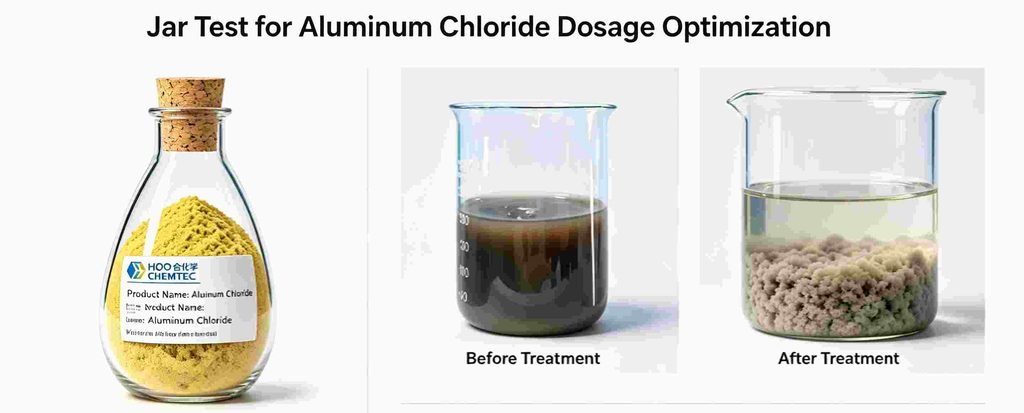
Jar testing is the standard practical method for screening and optimizing AlCl₃ dosage. While pilot testing, historical plant data, and online monitoring instruments can supplement jar testing, the bench-scale test remains the most direct way to evaluate coagulant performance under controlled conditions.
Key Water Quality Variables Affecting Dosage
Several raw water characteristics influence the required AlCl₃ dose:
- Turbidity: Higher turbidity generally increases coagulant demand, but particle surface charge effects complicate the relationship.
- Organic load (TOC/DOC): Natural organic matter consumes coagulant and interferes with floc formation, especially in colored surface waters.
- Temperature: Low water temperature slows hydrolysis and floc formation, requiring dose adjustment or longer mixing times.
- Raw water pH: The initial pH determines which aluminum species predominate and how much acid is needed to reach the target coagulation pH.
- Ionic strength: High dissolved solids compress the electrical double layer, reducing coagulant demand for charge neutralization.
Standard Jar Testing Protocol for AlCl₃ Evaluation
A typical jar test procedure includes rapid mixing, slow flocculation, and settling stages. The following values are illustrative starting conditions, not universal standards. Operators should adapt mixing intensity and duration to the specific jar tester geometry, paddle dimensions, and plant process.
| Stage | Illustrative Starting Conditions | Notes |
|---|---|---|
| Rapid mix (flash mixing) | 1–2 min at 100–150 rpm | Adjust based on jar geometry; target uniform coagulant dispersion |
| Slow mix (flocculation) | 15–30 min at 20–40 rpm | Floc growth phase; avoid shear that breaks flocs |
| Settling | 10–30 min without mixing | Allow floc settling; record settling velocity |
During the test, operators measure floc settling speed, turbidity removal percentage, residual aluminum concentration, and post-treatment pH. These results help select the dose that achieves the treatment objective while keeping pH and residual aluminum within limits.
Aluminum Chloride Jar Test Decision Table
The following troubleshooting reference helps interpret common jar test observations:
| Observation | Possible Cause | What to Check |
|---|---|---|
| Small, weak flocs | Under-dosing or unsuitable pH | Increase dose; verify pH |
| Large but fragile flocs | Over-dosing or poor flocculation conditions | Reduce dose; adjust mixing intensity |
| Good flocs but high residual Al | Excess dose or unsuitable final pH | Lower dose; check final pH |
| Fast settling but high residual turbidity | Poor particle destabilization | Check rapid mixing intensity and dose |
| pH drops sharply during test | Low alkalinity or excessive dose | Evaluate alkalinity addition; reduce dose |
This decision-support content helps engineers move from “what dose should I use” to “what is happening in my system and how to correct it.”
What Can Aluminum Chloride Remove? (Capabilities & Limitations)
AlCl₃ removes suspended solids, turbidity, and colloidal particles through coagulation and flocculation. Under suitable conditions, it may also reduce some color- and NOM-associated material, particularly fractions bound to turbidity or colloidal particles. However, it is not a broad-spectrum dissolved organic matter removal agent. NOM reduction depends on the nature of the organic matter and the coagulation pH.
What Aluminum Chloride Does Not Remove Well
AlCl₃ coagulation is not effective for removing:
- Dissolved salts (e.g., sodium, chloride, hardness ions)
- Most dissolved inorganic ions
- Many micropollutants and trace organic contaminants
- Contaminants requiring adsorption or membrane separation
Understanding these limitations sets realistic treatment expectations and guides process selection.
Phosphorus Removal Considerations
For phosphorus removal, aluminum-based chemistry involves precipitation, adsorption, and coprecipitation. The dominant pathway depends on pH, phosphate speciation, aluminum dose, and competing ions. Engineers should not view phosphorus removal as a simple single-reaction precipitation; it is a process-dependent mechanism that requires site-specific evaluation.
Aluminum Chloride in Water Treatment Applications (Application Matrix)
Engineers can evaluate AlCl₃ for municipal and industrial water treatment, but they should base product selection on water chemistry, treatment objectives, process design, and regulatory requirements. The matrix below offers a preliminary assessment framework.
| Application | Potential Role | Key Considerations & Limitations |
|---|---|---|
| Municipal Drinking Water | Coagulant for source water with suitable alkalinity | pH control, residual aluminum compliance, possible alkalinity supplementation; drinking water grade may require NSF/ANSI 60 or equivalent certification |
| Industrial Wastewater (Textile, Chemical, Food) | Coagulant/precipitation aid for suspended solids, color, and some phosphorus | Wastewater matrix variability; pre-testing required; sludge characteristics need evaluation |
| Phosphorus Removal | Co-precipitation and adsorption | Efficiency depends on pH, phosphate species, Al/P ratio, and competing ions; not a standalone solution in all cases |
| Color and Turbidity Reduction | Coagulation of colloidal and particulate material | May also reduce some NOM-associated color; effectiveness varies with organic character |
| Selected Metal-Containing Wastewater | Co-precipitation aid for specific metals | Metal removal depends on metal species, pH, competing ions, and overall process; AlCl₃ is not a universal heavy-metal precipitant |
| Coagulation Conditioning Before Sludge Dewatering | Part of a sludge conditioning program | Often combined with organic polymers or other inorganic coagulants; excess AlCl₃ can increase solids loading; dosage optimization is essential |
Aluminum Chloride vs. PAC for Water Treatment: Technical and Cost Comparison
AlCl₃ and PAC differ fundamentally in chemical form and hydrolysis behavior. They should not be treated as interchangeable products.
| Parameter | Aluminum Chloride (AlCl₃) | Polyaluminum Chloride (PAC) |
|---|---|---|
| Chemical Form | Simple aluminum salt | Pre-hydrolyzed aluminum polymer |
| Hydrolysis Behavior | Hydrolyzes rapidly after dosing | Partially pre-hydrolyzed |
| Basicity | Typically not specified as a product parameter | Important product specification, varies by grade |
| Alkalinity Demand | Depends on dose and raw water | Depends on basicity, dose, and raw water |
| pH Response | Strongly dependent on water chemistry | Depends on PAC basicity and water chemistry |
| Dosage Determination | Requires jar testing | Requires jar testing |
| Sludge Production | Process-dependent | Process-dependent |
| Cost Evaluation | Must include product price, required dose, and sludge handling cost | Must include product price, required dose, and sludge handling cost |
Neither product should be selected based only on unit price or a generic pH range. The correct comparison is treatment performance, required dose, pH control, sludge handling, and total cost per cubic meter of treated water.
Aluminum Chloride vs. Aluminum Sulfate (Alum)
AlCl₃ and aluminum sulfate (alum) are both acidic aluminum salts used as coagulants, but they differ in several operational aspects.
Low-temperature coagulation can be challenging for aluminum salts in general. The relative performance of AlCl₃ and alum depends on raw-water chemistry, pH, mixing conditions, and dose. When low-temperature performance is important, jar testing with the actual raw water is recommended rather than relying on generalized claims.
Other differences to consider include sludge characteristics, corrosivity, and logistics. The choice between the two products should be based on site-specific evaluation and total cost of ownership.
B2B Procurement Guide: How to Select and Source Aluminum Chloride
Product Form and Active Aluminum Basis
One of the most important but often overlooked aspects of AlCl₃ procurement is confirming the basis on which the product concentration is quoted. Buyers should verify whether the stated concentration refers to AlCl₃ content (wt% of aluminum chloride).
- AlCl₃ content (wt% of aluminum chloride)
- Al₂O₃ equivalent (aluminum oxide basis, commonly used in coagulant comparisons)
- Al content (elemental aluminum basis)
These are not the same. Failing to clarify the basis can lead to incorrect cost comparisons between suppliers or between AlCl₃ and alternative coagulants.
Critical quality specifications include:
| Specification | Why It Matters |
|---|---|
| AlCl₃ or Al₂O₃ content | Determines active chemical concentration and dosing economics |
| Iron (Fe) content | Can affect treated water color and residual metal compliance |
| Water-insoluble matter | Affects dosing system cleanliness and potential clogging |
| Heavy metals (As, Pb, Cd, etc.) | Critical for drinking water compliance |
| Physical form | Determines handling, storage, and dosing infrastructure |
| pH or acidity | Relevant for storage compatibility and dosing system design |
A Certificate of Analysis (CoA) should be requested for each batch. For drinking water applications, the product should meet relevant standards such as NSF/ANSI 60 or an equivalent certification.
Packaging, Storage, and Logistics
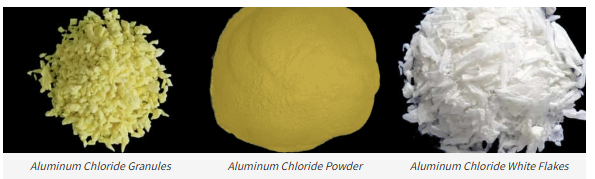
Solid AlCl₃ is typically packed in 25 kg bags or supersacks. Both forms are classified as hazardous for transport under UN numbers. Buyers should verify the exact product form when reviewing documentation.
Storage areas should be dry, ventilated, and separated from alkalis and incompatible materials.
Practical buyer checklist for water treatment procurement:
- Product grade (industrial vs. drinking water)
- Active aluminum basis confirmed (AlCl₃, Al₂O₃ equivalent, or Al)
- CAS number verified for the specific chemical form
- Certificate of Analysis (CoA) reviewed
- Safety Data Sheet (SDS) reviewed
- Minimum order quantity (MOQ) confirmed
- Packaging type (liquid IBC/bulk, solid bags/supersacks)
- Destination port logistics and hazardous goods documentation
- Drinking water certification if applicable
Final Call to Action
Evaluating aluminum chloride for your plant? Send HOO CHEMTEC your raw water metrics (pH, turbidity, alkalinity, TOC) and treatment goals for a tailored product specification, SDS, and bulk quotation. Our technical team will respond within 24 hours.


