In the water treatment industry, coagulant and flocculant are often mentioned together. This confuses many buyers. Are they the same product? Can you use only one? The truth is, while both help remove impurities, they work in very different ways.
A coagulant works by neutralizing electrical charges to destabilize suspended particles. A flocculant then acts like a bridge to bind those tiny particles into larger clumps. Understanding this difference is key to choosing the right chemical for your water treatment system.
This article will explain when to use each one and why sometimes you need both.
What Is a Coagulant?
A coagulant is a chemical that starts the water treatment process. Its main job is to break the stability of fine particles in water. These tiny particles usually carry a negative charge, which makes them repel each other. As a result, they stay suspended and never settle on their own.
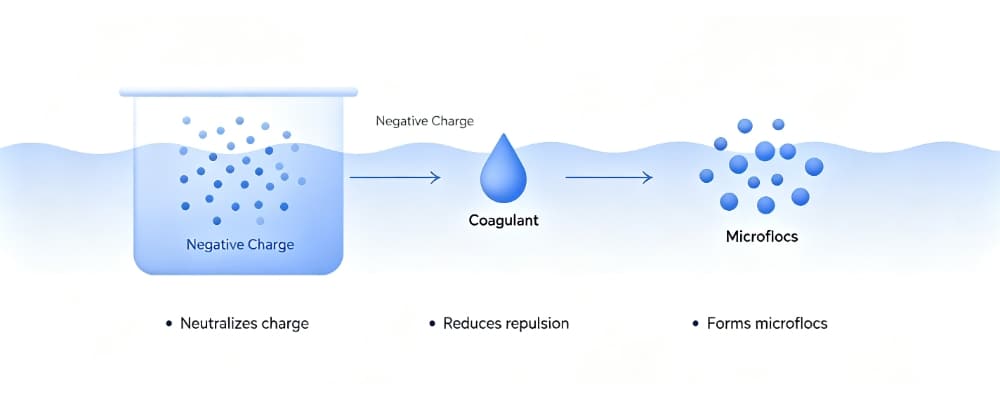
When you add a coagulant, it does three important things:
- It neutralizes the surface charge of particles.
- It removes the electrostatic repulsion between them.
- It forms small, visible clumps called microflocs.
This first step is critical. Without charge neutralization, no amount of mixing or settling will remove the fines. The coagulant prepares the particles so they can be further aggregated later.
Common coagulant products include:
- Polyaluminum Chloride (PAC)
- Aluminum Sulfate (Alum)
- Ferric Chloride
- Ferric Sulfate
- PolyDADMAC (a cationic organic coagulant)
Each type has its own best pH range and application. For example, PAC works well across a wider pH range than Alum. Ferric salts are often used for heavy metal removal.
In short, a coagulant handles the “chemistry” part of particle removal. It creates the conditions needed for effective solid-liquid separation. But it does not form large flocs on its own. That is where the next chemical comes in — the flocculant. We will cover that in the following section.
What Is a Flocculant?
While a coagulant handles charge neutralization, a flocculant plays a completely different role. Think of it as a molecular bridge. Its job is not to neutralize charges but to physically connect the tiny microflocs formed by the coagulant.
A flocculant uses long polymer chains to link these small clumps together. This process is called polymer bridging. The result is much larger, heavier agglomerates known as large flocs.
These large flocs are essential because they:
- Settle quickly under gravity
- Float easily in dissolved air flotation (DAF) systems
- Get captured efficiently in filtration media
Without a flocculant, the microflocs remain too small to separate effectively. They would pass through filters or take hours to settle.
Common flocculant products include:
Anionic PAM – good for neutral to alkaline water with high solids
Cationic PAM – effective for organic-rich wastewater
Nonionic PAM – works well in acidic conditions
Natural polymers (e.g., starch derivatives) – biodegradable options for sensitive applications
Unlike coagulants, flocculants are rarely used alone. They depend on the coagulant to first destabilize the particles. In summary, a flocculant takes what the coagulant started and amplifies it into a treatable form. Together, they make solid-liquid separation fast and efficient. Next, we will compare them side by side.
Key Differences Between Coagulant and Flocculant
Now that we understand what each chemical does individually, let us compare them directly. Although they work together in most treatment processes, coagulants and flocculants have completely different roles, mechanisms, and characteristics. Knowing these differences helps you choose the right product for your specific application.
Here is a clear comparison table:
| Comparison Item | Coagulant | Flocculant |
| Main Function | Neutralize charge | Bridge and aggregate |
| Working Stage | Step 1 (destabilization) | Step 2 (enlargement) |
| Mechanism | Charge neutralization | Polymer bridging |
| Product Type | Inorganic salts, organic coagulants | High-molecular-weight polymers |
| Forms Large Flocs? | No (only microflocs) | Yes (large, settleable flocs) |
| Can Be Used Alone? | Sometimes (low turbidity water) | Rarely (needs pre-coagulation) |
| Common Products | PAC, Alum, Ferric Chloride, Ferric Sulfate | Anionic/Cationic/Nonionic PAM |
As the table shows, a coagulant focuses on the chemistry of charge cancellation, while a flocculant focuses on the physical binding of particles. One cannot replace the other. In most real-world applications, you need both to achieve efficient solid-liquid separation. In the next sections, we will explore exactly how they work together and when you might use only one.
How Coagulant and Flocculant Work Together
Understanding how these two chemicals cooperate is essential for designing an effective water treatment system. They perform two distinct but complementary tasks. The coagulant starts the process, and the flocculant finishes it. Neither can fully succeed without the other in most cases.
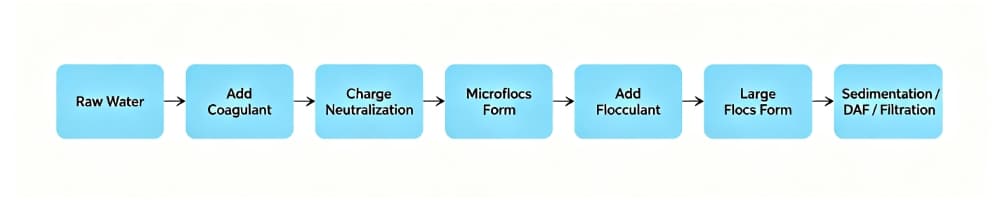
Here is a simple flow chart showing the typical sequence:
Let us walk through each step:
Step 1 – Add Coagulant: The coagulant is mixed rapidly into the raw water. It immediately begins neutralizing the negative charges on suspended particles.
Step 2 – Charge Neutralization: Once the charges are canceled, particles no longer repel each other. They start to collide and stick together.
Step 3 – Microflocs Form: These collisions create tiny, barely visible clumps called microflocs. They are still too small to settle or filter effectively.
Step 4 – Add Flocculant: At this point, a flocculant is introduced under gentle mixing. Its long polymer chains attach to multiple microflocs at once.
Step 5 – Large Flocs Form: The polymer bridges pull microflocs together into large, dense flocs. These flocs are now heavy enough to sink or float.
Step 6 – Separation: The large flocs are removed by sedimentation, dissolved air flotation (DAF), or filtration.
The key point is that the coagulant handles the “start” by breaking particle stability. The flocculant handles the “amplify” by building size and weight. If you skip either step, performance drops significantly. Without coagulation, particles remain charged and never form even microflocs. Without flocculation, microflocs stay too small to separate quickly.
In short, coagulation and flocculation are a team. One sets the stage; the other delivers the result. In the next section, we will discuss situations where you may only need a coagulant.
When Do You Only Need a Coagulant?
Although coagulants and flocculants often work as a pair, there are several situations where a coagulant alone is sufficient. In these cases, adding a flocculant may be unnecessary or even counterproductive. Below are three common scenarios.
① Drinking Water Treatment with Low Turbidity
Many drinking water plants treat source water that already has low turbidity. The suspended solids are few and fine. Here, a coagulant like PAC can neutralize the charge and form small flocs that are easily captured by sand filters. Adding a polymer flocculant is often not required. PAC alone provides clean water within regulatory limits.
② Chemical Precipitation Processes
For removing specific contaminants like phosphorus or heavy metals, chemical precipitation relies heavily on coagulants. Metal salts such as ferric chloride or aluminum sulfate react with phosphate or metal ions to form insoluble precipitates. These precipitates settle on their own or are removed by filtration. A flocculant is rarely needed unless the precipitate particles are extremely fine.
③ Strong Downstream Filtration Capacity
Some treatment systems have powerful downstream equipment, such as membrane filtration or multi-media filters. In these setups, the microflocs formed by a coagulant are small enough to be retained by the filter media. Adding a flocculant could actually clog the membranes or shorten filter run times. Therefore, operators often skip the polymer entirely.
In summary, a coagulant-only approach works well when the water has low solids, when chemical precipitation is the goal, or when downstream filtration is strong enough to capture microflocs. However, for high-turbidity wastewater or rapid settling requirements, a flocculant becomes necessary. We will explore those situations in the next section.
When Must You Use Both Coagulant and Flocculant?
In many real-world applications, using only a coagulant is not enough. When the water contains high levels of pollutants, fine solids, or color, you need both chemicals to achieve effective treatment. This is especially true for industrial wastewater and systems that require fast separation. Let us look at the key scenarios and industries.
High Solids, High COD, and Deep Color
When raw water has high suspended solids (SS), high chemical oxygen demand (COD), or intense color, a single coagulant cannot produce large enough flocs. The microflocs formed after coagulation are too light to settle quickly. Adding a flocculant bridges these microflocs into heavy, dense flocs that settle rapidly. Without the flocculant, the treatment time becomes too long, and effluent quality suffers.
Dissolved Air Flotation (DAF) Systems
DAF systems rely on tiny air bubbles to lift flocs to the surface. For this to work, the flocs must be large and sturdy. A coagulant alone creates weak, small microflocs that break apart easily during bubble attachment. A flocculant strengthens and enlarges the flocs, making them stable enough to float. Both chemicals are essential for DAF efficiency.
Industrial Wastewater Applications
Different industries generate wastewater with unique challenges. Here are common examples:
Textile Industry: Wastewater contains dyes, high color, and surfactants. Coagulants remove color by neutralizing dye molecules, but flocculants are needed to form settleable flocs from the fine color precipitates.

Paper Industry: Whitewater from paper machines has high fiber and filler content. A coagulant destabilizes the fibers, and a flocculant aggregates them for recycling or disposal.
Mining Industry: Mine tailings contain fine mineral particles that stay suspended for days. Coagulants reduce repulsion, and anionic PAM flocculants create large flocs for rapid dewatering.
Food Processing: Wastewater from food plants has high organic load and fats. Coagulants break emulsions, while flocculants gather the organic solids for separation.
Municipal Wastewater: Primary and secondary treatment often use both chemicals to improve sludge settling and reduce phosphorus levels.
Electroplating: Heavy metals like copper and nickel are precipitated with coagulants, and flocculants ensure the metal hydroxides settle completely.
Why Combination Is Necessary
The reason is simple: coagulants handle the chemistry, and flocculants handle the physics. In challenging waters, you cannot skip either step. The coagulant creates the conditions for particle collision, but only the flocculant builds the size and weight needed for practical separation. Skipping the flocculant leaves you with slow-settling microflocs. Skipping the coagulant means the flocculant has nothing to bridge.
In summary, whenever you face high turbidity, high organic loads, deep color, or fast separation requirements, plan to use both chemicals. In the next section, we will discuss how to select the right combination for your specific water quality.
How to Choose the Right Coagulant and Flocculant Combination
Selecting the correct chemicals for your water treatment system is not a one-size-fits-all decision. The right combination depends on several factors related to your water quality and operating conditions. Here are the key considerations.
Water Quality Characteristics
Your raw water composition determines which chemicals will work best.
- Suspended Solids (SS): High SS requires stronger coagulants and higher molecular weight flocculants.
- COD and Organic Load: High organic content often favors cationic coagulants and cationic PAM.
- Color: Deep color from dyes or humic acids responds well to PAC or ferric salts.
- Oil and Grease: Emulsified oils need coagulants to break the emulsion first.
- Heavy Metals: Ferric chloride or aluminum salts are effective for metal precipitation.
- pH Level: Each product has an optimal pH range. PAC works from pH 5 to 9, while alum performs best around pH 6 to 7. Always match the chemical to your water pH.
Temperature and Mixing Conditions
Temperature affects reaction speed and viscosity. Cold water slows down coagulation and flocculation. You may need higher doses or longer mixing times in winter.
Mixing conditions also matter:
• Rapid Mixing: Coagulant needs fast, turbulent mixing (300–1000 rpm) for immediate dispersion.
• Slow Mixing: Flocculant requires gentle mixing (30–60 rpm) to avoid breaking the delicate flocs.
Poor mixing ruins performance regardless of chemical choice.
Jar Test – Never Skip This
The most reliable way to find the right combination is a jar test. This simple lab procedure simulates your full-scale process using small beakers.
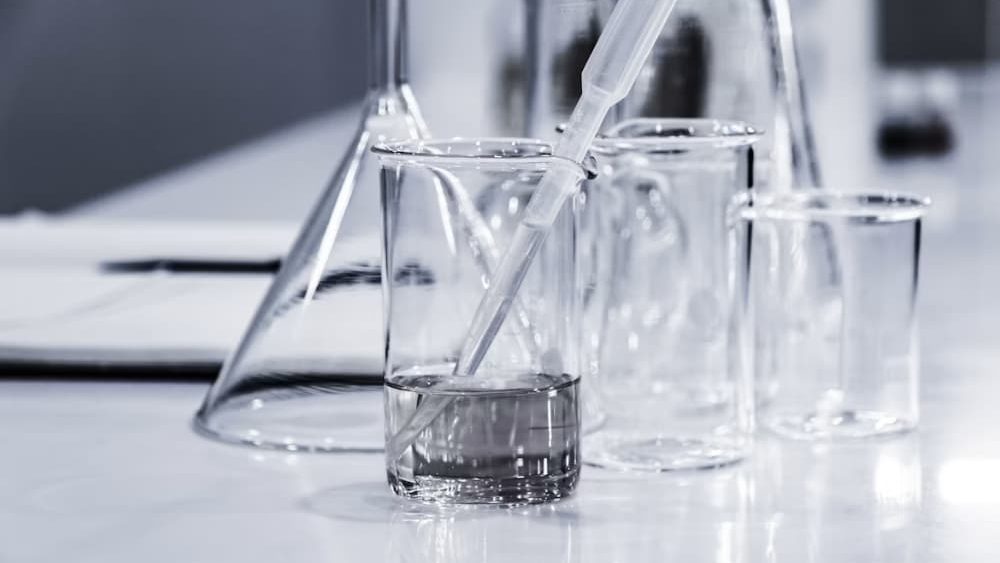
Why jar tests are essential:
- They reveal the exact dose needed for your specific water.
- They show the optimal pH and mixing speed.
- They prevent overdosing, which wastes money and can cause problems.
- Every water source is different. Do not copy another plant’s dosage blindly.
In summary, always analyze your water quality first, consider temperature and mixing, and confirm your choice with a jar test. This systematic approach saves time, chemicals, and money. In the final section, we will wrap up everything we have covered.
Conclusion
Coagulants and flocculants are often used together, but they serve completely different purposes. A coagulant destabilizes colloidal particles by neutralizing their surface charge. A flocculant then bridges those tiny microflocs into large, settleable flocs. Understanding this distinction is the key to efficient and cost-effective water treatment.
Choosing the right chemical combination depends on your water quality, treatment goals, and operating conditions. A proper selection improves removal rates, reduces chemical waste, and lowers overall costs.
As a professional water treatment chemical supplier, HOO CHEMTEC offers a wide range of coagulants including PAC, Ferric Chloride, and Ferric Sulfate, as well as various ionic types of Polyacrylamide (PAM) flocculants. We provide suitable products and technical support for drinking water, municipal wastewater, and industrial effluent treatment. Our goal is to help customers optimize treatment performance and operational costs.
FAQ
Which is more expensive—coagulant or flocculant?
Generally, coagulants (like PAC or alum) are cheaper per kilogram, but total treatment cost depends on dosage. Flocculants (especially high‑molecular‑weight PAM) cost more per unit but are used at much lower doses. A jar test helps you find the most cost‑effective combination for your specific water.
How should I store coagulants and flocculants?
Coagulants (liquid or powder) should be stored in dry, cool areas away from moisture. Many are corrosive—use acid‑resistant tanks and PPE. Flocculants, especially PAM powders, must be kept sealed and dry; they absorb humidity quickly and lose effectiveness. Never store them near strong oxidizers.
What happens if I add flocculant before coagulant?
Adding flocculant first is ineffective because the particles still carry negative charges and repel each other. The polymer chains have nothing to bridge. You’ll see little floc formation and poor settling. Always follow the sequence: coagulant first (rapid mix), then flocculant (gentle mix).
Do coagulants and flocculants work in cold water or high‑salinity water?
Cold water slows chemical reactions and increases viscosity, requiring higher doses or longer mixing times. High salinity (e.g., seawater or brine) can interfere with charge neutralization—inorganic coagulants may still work, but polymer flocculants may lose viscosity. Special high‑salt‑tolerant flocculants are available.