Anhydrit polymaleic thủy phân (HPMA) is a polymer-based scale inhibitor used in industrial water treatment. It helps control mineral deposition by interfering with crystal formation and growth. Formulation developers may combine HPMA with 1-hydroxyethylidene-1,1-diphosphonic acid (HEDP), axit polyacrylic (PAA) or ethylenediamine tetramethylene phosphonic acid (EDTMPS) to meet different HPMA water treatment requirements.
The best combination depends on the target scale, thông số kỹ thuật sản phẩm, hóa học nước, và điều kiện hoạt động. This guide reviews published research and available technical information on these three HPMA combinations, with a focus on formulation choices and performance evaluation.
Why Combine HPMA with Other Water Treatment Chemicals?
Scale forms when dissolved minerals become supersaturated, crystallize and deposit on equipment surfaces. Calcium carbonate is a common concern in cooling water. Calcium hardness, độ kiềm, PH, nhiệt độ, cycles of concentration and flow all affect how much scale develops.
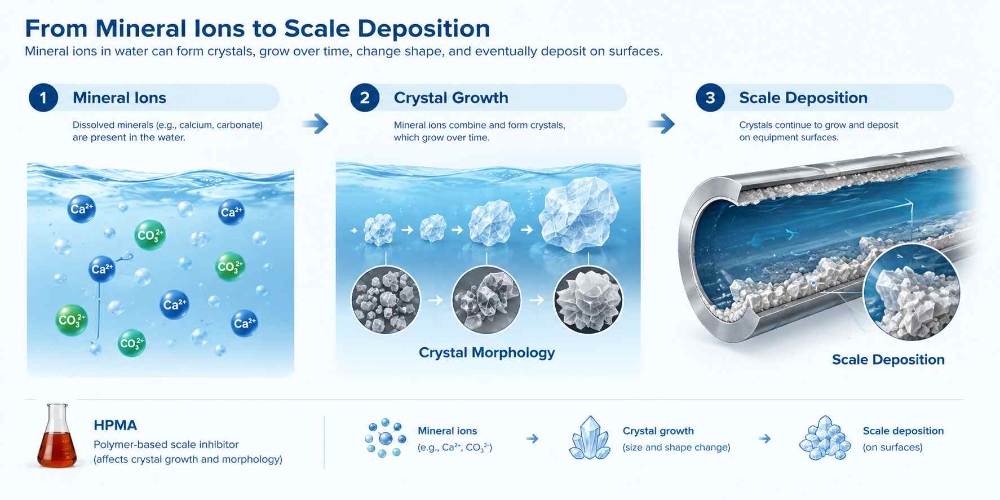
HPMA interacts with calcium ions and interferes with calcium carbonate crystal growth. It also changes the shape of precipitated crystals, which may affect how easily they aggregate and stick to surfaces. Its performance still depends on the mineral involved and the water chemistry.
Other chemicals add different functions. HEDP and EDTMPS are phosphonates that interfere with crystal formation and growth. PAA is a polymer that supports scale control and disperses particles. A blend can therefore address more than one step of the deposition process. More ingredients do not guarantee better results, so test data should decide the formulation, not ingredient count.
HPMA and HEDP: Polymer–Phosphonate Formulations
Thủy phân polymaleic anhydride (HPMA) and 1-hydroxyethylidene-1,1-diphosphonic acid (HEDP) differ in structure and role. HEDP is an organophosphonate that can interfere with mineral nucleation and crystal growth. HPMA can also affect calcium carbonate crystal growth and morphology. Their combination should therefore be evaluated for its overall effect on precipitation and deposition, rather than assuming that the two ingredients will always provide better control together.
Shen et al. (2012) studied synthesized HPMA and its effect on calcium carbonate crystals. The authors reported that HPMA changed the morphology and crystal structure of the precipitates. They also reported that HEDP and PAA enhanced HPMA’s effects under the conditions tested. This result supports further work on HPMA–HEDP blends. It does not prove that every commercial HPMA and HEDP product performs the same way, because the study used synthesized HPMA and laboratory methods that differ from an operating plant.
Trong thực tế, compare HPMA alone, HEDP alone and the blend at comparable active dosages. Check calcium hardness, độ kiềm, PH, temperature and cycles of concentration. Confirm the active content of each product, because a ratio based on supplied products differs from one based on active ingredients. Choose the blend only if the performance gain justifies its handling needs and cost.
HPMA and PAA: Polymer-Based Antiscalant Formulations
Thủy phân polymaleic anhydride (HPMA) and polyacrylic acid (PAA) are both polymers, nhưng chúng không thể thay thế cho nhau. HPMA influences calcium carbonate crystal growth and morphology. PAA supports scale control and disperses suspended particles, which reduces aggregation. A combination suits programs that need both crystal-growth control and dispersion.
Shen et al. (2017) optimized a three-component mixture of HEDP, PAA and synthesized HPMA using a simplex-lattice design. The optimized mass ratio in that specific formulation was HEDP:PAA:HPMA = 10:10:80. Under the study’s conditions, the mixture reached 84% antiscaling efficiency in a calcium carbonate precipitation test Và 95% in a calcium carbonate scale-deposition test. The authors also reported changes in crystal growth, morphology and structure.
Treat these figures as a development reference, not a performance guarantee. The study used specific materials and test methods. Commercial products differ in active content and polymer properties, and cooling systems differ in water chemistry. Các 10:10:80 ratio is a mass ratio of the study’s components, so confirm whether your calculation uses supplied product mass or active mass before adapting it.
When you adapt the blend, compare it with two-component combinations and single ingredients under consistent conditions. Judge compatibility, liều lượng, storage stability and cost per treated volume. If your program already contains PAA, count its contribution before adding another polymer.
HPMA and EDTMPS: Compatibility and Application Considerations
EDTMPS, commonly supplied as a sodium salt, is an organophosphonate used in industrial water treatment, including cooling-water and boiler-water programs. HPMA is a polymer-based scale inhibitor. A combination may suit programs that must control scale under specific boiler or water system requirements.
Public guidance for this pair is more application-specific than for the other two combinations. Some suppliers report an EDTMPS:HPMA ratio of 1:3 for internal treatment of low-pressure boilers. That figure comes from supplier technical data, not from independent comparative studies. Treat it as a candidate for evaluation, not as an optimum, and check it against the technical data sheets of the products you plan to use.
The ratio basis deserves attention. MỘT 1:3 ratio may refer to products as supplied. EDTMPS and HPMA grades differ in active content, so the same supplied-product ratio can mean different active ratios.
Boiler programs also require a review of operating pressure, nhiệt độ, feedwater chemistry and target deposits. Confirm phosphonate behavior under operating conditions with product documentation and qualified technical guidance. Check compatibility with other treatment chemicals and the dosing method. Do not assume synergy between HPMA and EDTMPS. Test the blend under representative conditions.
Comparison of HPMA-Based Formulations
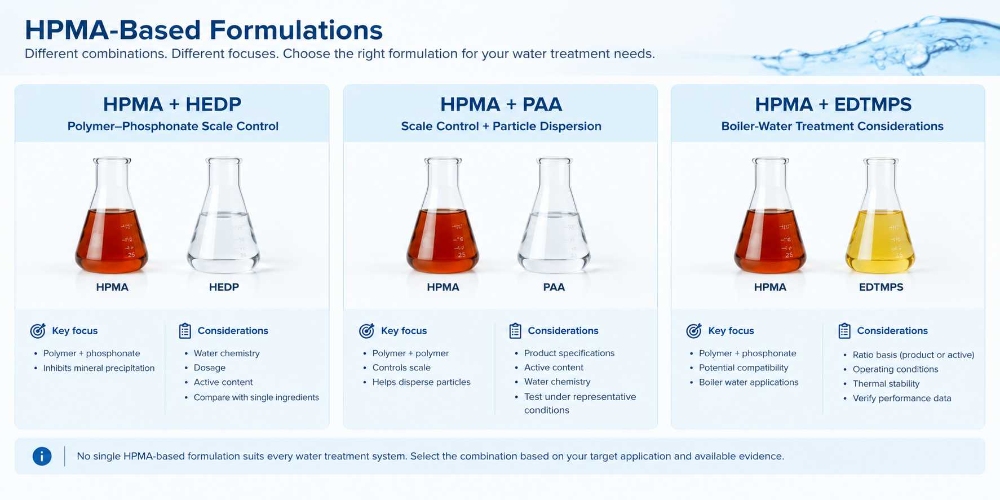
| Combination | Main focus | Available evidence | Key consideration |
|---|---|---|---|
| HPMA + HEDP | Polymer–phosphonate control | Laboratory study (Shen et al., 2012) | Verify in target water |
| HPMA + PAA | Crystal control and dispersion | Three-component study at 10:10:80 | Ratio is test-specific |
| HPMA + EDTMPS | Low-pressure boiler programs | Supplier guidance (1:3) | Confirm ratio basis and conditions |
No formulation suits every water system. Select the combination by application and test results.
How to Evaluate HPMA Formulation Performance
Four checks cover the essentials.
1. Khả năng tương thích hóa học
An HPMA compatibility test starts with the intended commercial products, mixed under suitable handling conditions. Look for precipitation, phase separation, discoloration and changes during storage. A clear mixture can still perform poorly, so follow compatibility checks with performance tests.
2. Hiệu suất ức chế quy mô
An HPMA scale inhibition test should reflect the target scale and water chemistry. For calcium carbonate, set the calcium concentration, độ kiềm, PH, temperature and test duration. Compare the blend with HPMA alone, the other active alone and an untreated control, all under identical conditions.
3. Dosage and ratio
Separate three measurements:
- Commercial product mass ratio: the relative amounts of products as supplied.
- Active ingredient mass ratio: the relative amounts of the actual actives.
- Application dosage: the concentration added to the water system.
These values are not interchangeable. Confirm each product’s active content and record which basis every ratio uses.
4. Application validation
Laboratory results are a starting point, not proof of plant performance. Check temperature, pressure where relevant, water chemistry and interactions with other treatment chemicals. Run controlled comparative tests before any larger trial.
Câu hỏi thường gặp
What Is HPMA Used for in Water Treatment?
HPMA serves as a scale inhibitor and dispersant in industrial water treatment. It interferes with calcium carbonate crystal growth and alters precipitate morphology. Results depend on water chemistry, dosage and operating conditions.
Can HPMA Be Combined with HEDP or PAA?
Đúng. Researchers have studied HPMA with HEDP and PAA for calcium carbonate control, including a three-component HEDP–PAA–HPMA formulation. The suitable composition depends on product specifications, hóa học nước, dosage and operating conditions.
Can HPMA and EDTMPS Be Used Together?
Some suppliers list HPMA–EDTMPS combinations for low-pressure boiler treatment and report an EDTMPS:HPMA ratio of 1:3. Confirm whether that ratio uses supplied products or active ingredients. Check compatibility and boiler conditions before use.
Is There a Standard Mixing Ratio for HPMA-Based Formulations?
No single ratio fits every HPMA formulation. Các 10:10:80 ratio (HEDP:PAA:HPMA) và 1:3 supplier ratio (EDTMPS:HPMA) apply to specific contexts. The suitable ratio depends on active content, hóa học nước, target scale and operating conditions.
Vật tư HOO CHEMTEC HPMA, HEDP, PAA Và EDTMPS for industrial water treatment. Visit the product pages for specifications, or email enquiry@hoochemtec.com to request TDS, SDS and packaging details. Share your application and target water conditions so our team can respond to your needs.
References
- Shen, Z., Li, J., Xu, K., Ding, L., and Ren, H. (2012). The effect of synthesized hydrolyzed polymaleic anhydride (HPMA) on the crystal of calcium carbonate. Khử muối, 284, 238–244. https://doi.org/10.1016/j.desal.2011.09.005
- Shen, Z., Shi, J., Zhang, S., Fan, J., and Li, J. (2017). Effect of optimized three-component antiscalant mixture on calcium carbonate scale deposition. Water Science & Technology, 75(2), 255–262. https://doi.org/10.2166/wst.2016.512