Sodium formate is commonly purchased as a solid, while potassium formate is available as both a solid and a concentrated liquid. Neither is automatically the better deicer for every site. The right choice depends on the required application, nhiệt độ hoạt động, spreading or dosing equipment, product specification, local requirements and total delivered cost.
Đối với các nhóm mua sắm, the useful comparison is not just price per tonne. Compare active content, hàm lượng nước, bao bì, xử lý, performance data at the site’s expected temperature, and any approval or material-compatibility requirements. HOO CHEMTEC supplies sodium formate and potassium formate in different grades; request the current TDS and COA for the grade under review.
1. Natri Formate vs. Kali Formate: Quick Comparison
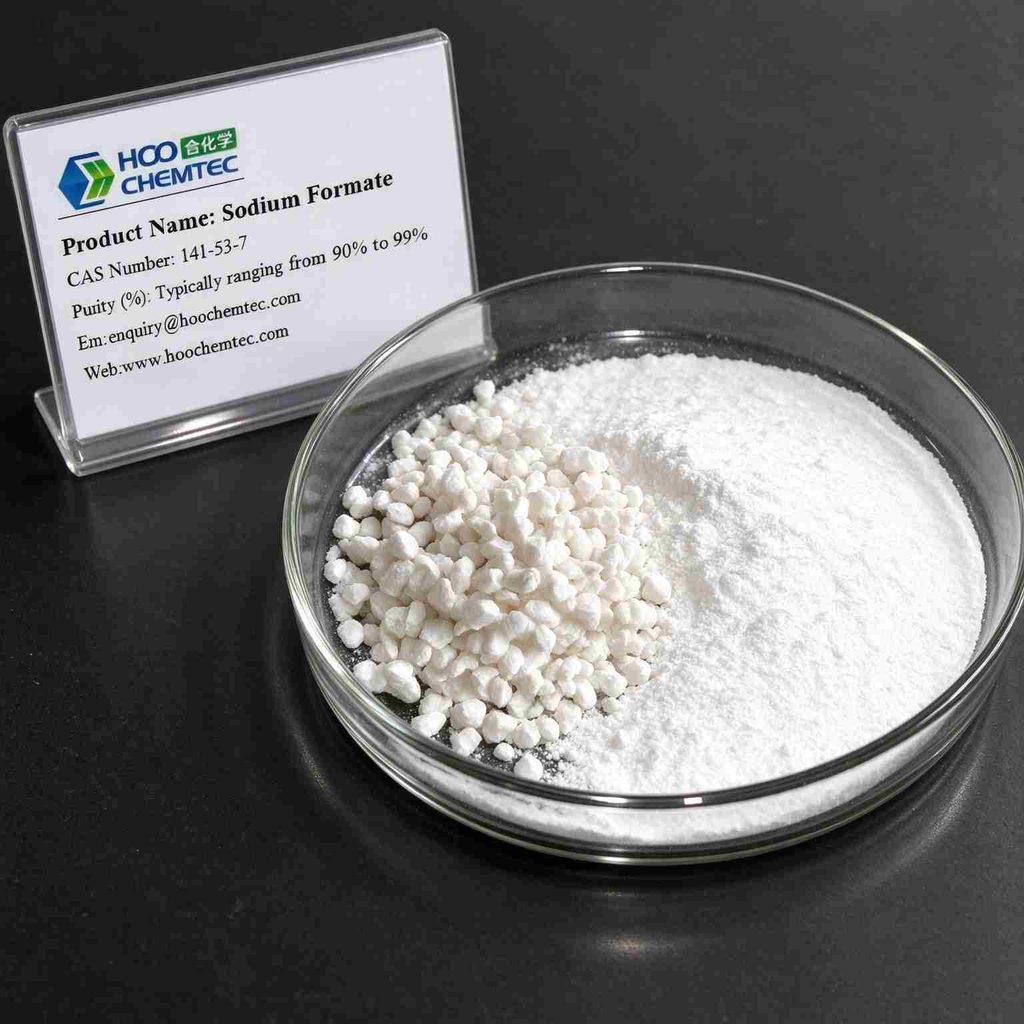
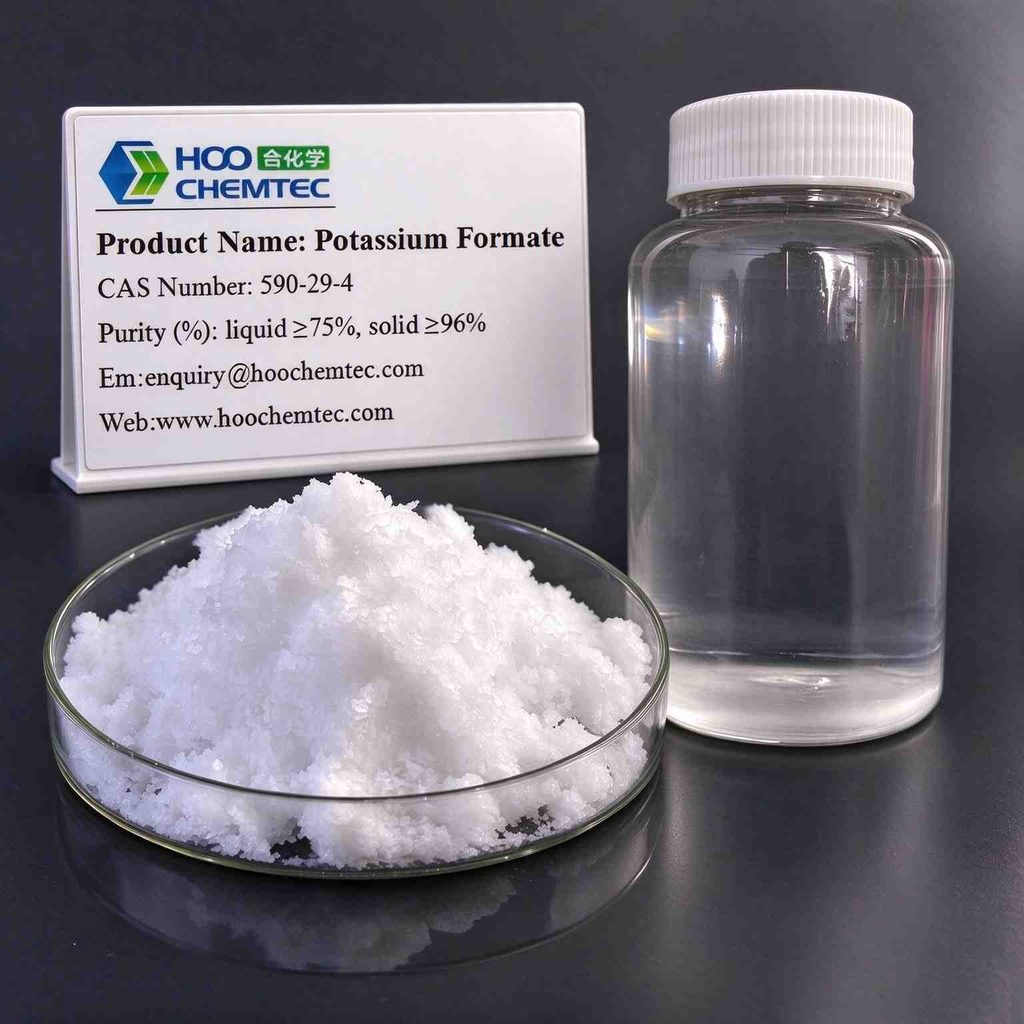
| Comparison point | Natri formate | Potassium formate |
| Số CAS | 141-53-7 | 590-29-4 |
| Công thức | HCOONa / CHNaO₂ | HCOOK / CHKO₂ |
| Common supply form | Bột tinh thể trắng hoặc hạt; solid grades | Clear liquid solution or solid flakes/crystals |
| HOO listed grade range | Typically 90–99% solid grades; confirm exact specification | Liquid ≥75%; rắn ≥96%; confirm current specification |
| Useful operational fit | Solid handling, bagged supply, dry spreading or preparation of solutions | Liquid dosing and operations that prefer a ready-made concentrated solution; solid for dry logistics |
| Main purchasing checks | xét nghiệm, độ ẩm, kích thước hạt, tạp chất, bao bì | xét nghiệm, Tỉ trọng, PH, crystallization/storage temperature, tạp chất, bao bì |
| Important limitation | Site performance depends on concentration, temperature and application method | Same; liquid density and crystallization behaviour are grade-specific |
These are product-selection starting points, not a performance ranking. Confirm the exact grade, test method and site requirements before placing a bulk order.
2. Tính chất vật lý và độ hòa tan
The following reference values help with preliminary technical comparison. Solid-salt density is not the same as the density of a commercial aqueous solution. For logistics, tank sizing and dosing, use the supplier’s specification for the actual product concentration and measurement temperature.
| Tài sản | Natri formate (chất rắn) | Potassium formate (chất rắn) | How to use the data |
| Trọng lượng phân tử | Xấp xỉ. 68.01 g/mol | Xấp xỉ. 84.12 g/mol | Useful for stoichiometric calculations, not a direct measure of deicing performance. |
| Độ hòa tan trong nước (reference) | Về 97 g/100 mL water at 20°C | Reported as about 331 g/100 mL water around 18–25°C in reference compilations | Values depend on source, temperature and reporting basis; confirm before using for process design. |
| Solid density (reference) | Về 1.9 g/cm³ | Về 1.91 g/cm³ | Crystalline-solid density; do not use as liquid solution density. |
| Commercial potassium formate 75% giải pháp | Not applicable to solid sodium formate data | Example supplier specification: density 1.57–1.58 g/cm³ at 25°C; pH 9–10 at 25°C | This is a supplier-specific example, not a universal specification for all 75% giải pháp. |
| PH | Aqueous solution is reported as approximately neutral in reference data | Aqueous solution pH depends on concentration and grade; a commercial 75% solution example reports pH 9–10 at 25°C | Always compare pH at the same concentration and test temperature. |
Sources for reference properties: PubChem’s sodium formate record and potassium formate record, and Perstorp’s Potassium Formate 75% product data sheet. Reference values should be treated as general chemical data, not as a substitute for a lot-specific COA or TDS.
PubChem: Natri formate | PubChem: Potassium formate
3. Rắn vs. Chất lỏng: Which Product Form Fits Your Operation?
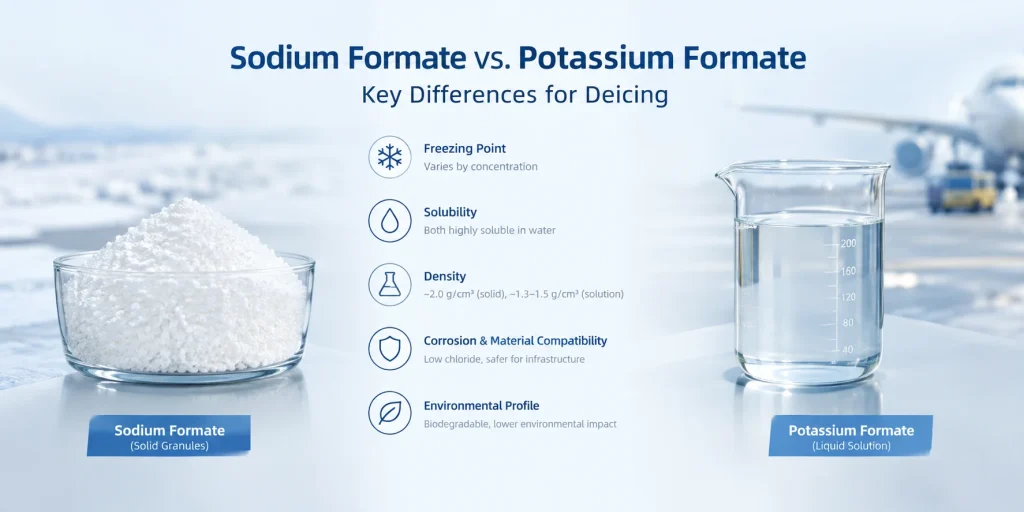
Choose a solid grade when…
Your equipment is designed for dry spreading or you prepare the solution on site.
You want to transport a concentrated solid and can manage dissolution, dust control and dry storage.
Your dosing system can handle the particle size and flow characteristics of the selected powder, granule or flake.
Consider potassium formate solution when…
Your operation uses liquid tanks, pumps and metered dosing.
You want to avoid on-site dissolving and have suitable storage materials and temperature controls.
The quoted density, concentration and crystallization/storage conditions match your process.
MỘT 75% potassium formate solution can be more convenient for liquid dosing, but it includes water and is heavier to ship per kilogram of active salt than a high-assay solid. A solid may reduce water freight but adds handling and solution-preparation steps. Compare total operating cost, not product form in isolation.
4. Chloride-Free Deicer, Corrosion and Environmental Considerations
Sodium formate and potassium formate are formate salts and do not intentionally use chloride as the deicing active ingredient. Tuy nhiên, the label “chloride-free” does not mean “non-corrosive,” “zero environmental impact,” or “safe for every material.” Trace chloride may still be present depending on product grade, and corrosion behaviour depends on the metal, sự tập trung, exposure duration, temperature and other formulation ingredients.
For airports, cầu, reinforced concrete, vehicles and sensitive equipment, request test data relevant to the substrate and operating conditions. Review local discharge limits and environmental requirements, and check whether the end-use site requires an approved formulated product rather than a commodity raw material.
Câu hỏi thường gặp: Is a chloride-free deicer non-corrosive?
KHÔNG. Chloride-free describes the absence of chloride as an intended ingredient, not the absence of corrosion risk. Ask for the product’s chloride limit, corrosion test method and results for the relevant materials.
5. So sánh chi phí: Calculate Cost per Kilogram of Active Salt
A fair first-pass comparison converts the quoted price into a cost per kilogram of active formate. Use the actual assay from the quotation or COA, not just the grade name.
Hypothetical example — figures below are for calculation only and are not market quotations:
| Sản phẩm | xét nghiệm | Active salt in 1,000 kg product | Cost per kg active salt |
| Solid formate | 96% | 1,000 × 0.96 = 960 kg | Quoted price per tonne ÷ 960 |
| Potassium formate solution | 75% | 1,000 × 0.75 = 750 kg | Quoted price per tonne ÷ 750 |
At these assays, 1 tonne of 96% solid contains 960 kg of active salt. To supply the same 960 kg of active salt using a 75% giải pháp, you need 960 ÷ 0.75 = 1,280 kg of solution. This comparison excludes freight, bao bì, kho, xử lý, on-site dissolution, heating or crystallization control, and differences in field performance.
Use this formula for each quotation: cost per kg active salt = delivered product price ÷ (product mass × assay fraction). Then compare the cost per treated area or per unit of ice-melting performance if reliable, comparable application data are available.
6. How to Choose a Deicing Agent for Airports, Roads and Other Sites
Define the use: runway deicer, taxiway/apron treatment, road or bridge pavement, parking structure, or another application. Do not assume one product qualification applies to all uses.
Set the operating envelope: expected air and pavement temperatures, precipitation type, application rate, and the time available for treatment.
Choose solid or liquid based on spreading equipment, xe tăng, máy bơm, on-site mixing and winter storage conditions.
Request comparable technical data: xét nghiệm, tạp chất, density at a stated temperature for liquids, pH at a stated concentration, crystallization/freezing curve and test method.
Check material compatibility, corrosion data, environmental restrictions, discharge requirements and any airport/road authority approvals.
Compare landed cost and operational cost, including transport, kho, xử lý, dilution, application equipment and replenishment frequency.
7. Buying Checklist for B2B Purchasers
Exact product name, CAS number and intended application
Assay and test method; lot-specific COA
Độ ẩm, chloride and other impurity limits where relevant
Appearance and particle-size range for solids
Density at a stated temperature and pH at a stated concentration for liquids
Crystallization/storage temperature and winter handling instructions
Tùy chọn đóng gói, net weight, pallet/loading details and export documents
SDS, TDS, shelf-life and storage conditions
Required product approvals or performance-test evidence for the intended site
Delivered price, thời gian dẫn, minimum order quantity and destination port
8. HOO CHEMTEC Formate Products
HOO CHEMTEC supplies formate products for industrial buyers. Review the product pages below for the currently listed grades and contact the team to confirm the exact specification, bao bì, availability and suitability for your application.
Sodium formate granules and solid grades
Potassium formate solution (75%) and solid grades
Browse HOO CHEMTEC deicing agents
Natri formate: của cải, công dụng, grades and buying guide
Để có một báo giá, share the intended application, target assay, solid or liquid preference, số lượng yêu cầu, bao bì, destination country/port and any technical or approval requirements.
Liên hệ: enquiry@hoochemtec.com | www.hoochemtec.com | WhatsApp: +86 16696202111
Câu hỏi thường gặp
Is sodium formate or potassium formate better for deicing?
There is no universal winner. Compare the intended use, temperature range, application equipment, required approvals, active-content cost and verified performance data.
Can potassium formate be used as a runway deicer?
Do not infer runway suitability from the raw material alone. Confirm the formulated product meets the applicable airport requirements and current qualification standards, including any requirements based on SAE AMS1435.
What is the density of potassium formate 75% giải pháp?
Density is grade- and temperature-specific. One manufacturer’s product sheet lists 1.57–1.58 g/cm³ at 25°C for its 75% sản phẩm; use the current TDS for the exact product being purchased.
What is the solubility of sodium formate?
Reference data report about 97 g per 100 mL of water at 20°C. Solubility figures depend on temperature and reporting basis, so confirm them before using them in process design.
Does chloride-free mean non-corrosive?
KHÔNG. Chloride-free does not eliminate corrosion risk. Ask for relevant corrosion test data and check compatibility with the site’s materials.
How should I compare solid and liquid prices?
Calculate delivered price per kilogram of active salt using the product assay, then include freight, bao bì, kho, xử lý, solution preparation and performance under comparable conditions.
What information should I send for a quote?
Specify application, target grade/assay, product form, Số lượng, bao bì, điểm đến, delivery terms and any required TDS, COA, SDS or performance approvals.