Clorhidrato de aluminio (Hol) y sulfato de aluminio (Alumbre) Son dos coagulantes a base de aluminio ampliamente utilizados en el tratamiento de agua.. Ambos ayudan a eliminar la turbidez., sólidos suspendidos, and colloidal particles from water. They support clarification by destabilizing fine particles and allowing them to form larger flocs that can settle or be removed through filtration.
Sin embargo, ACH and Alum differ in their chemical properties, especially basicity. These differences affect pH control, alkalinity consumption, entrenamiento de salpicaduras, and overall treatment costs.
Entonces, which coagulant should you choose? The answer depends on your raw water quality, proceso de tratamiento, and operating priorities. Understanding the differences between ACH and Alum can help water treatment plants and industrial buyers make a more informed decision.
What Are Aluminum Chlorohydrate and Aluminum Sulfate?
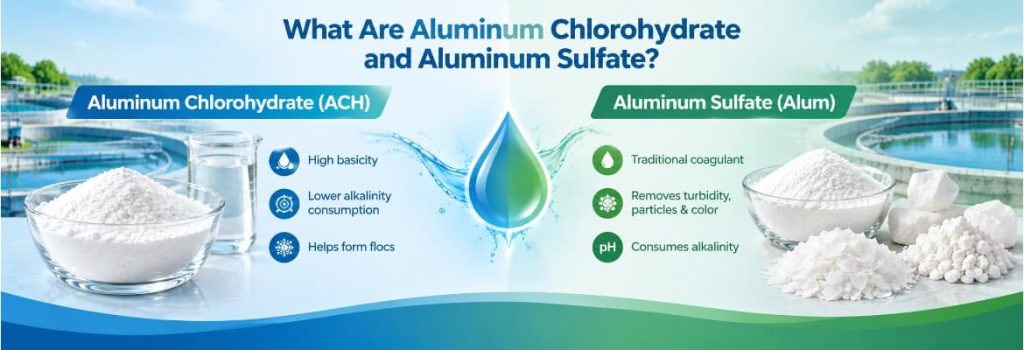
2.1 What Is Aluminum Chlorohydrate (Hol)?
Clorhidrato de aluminio (Hol) is a high-basicity aluminum coagulant used in drinking water treatment, tratamiento de aguas residuales, and other industrial water treatment processes. It belongs to the family of pre-hydrolyzed aluminum coagulants.
Because ACH contains pre-neutralized aluminum species, it generally consumes less alkalinity than conventional Alum. This property makes ACH particularly useful in some low-alkalinity waters, where maintaining a suitable pH can be challenging.
ACH can help destabilize colloidal particles and form flocs for subsequent separation. Sin embargo, its performance still depends on the product grade, dosificación, ph, and characteristics of the water being treated.
2.2 What Is Aluminum Sulfate (Alumbre)?
Sulfato de aluminio, commonly known as Alum, is a traditional inorganic coagulant used in municipal drinking water treatment and wastewater treatment. It helps remove turbidity, partículas suspendidas, natural organic matter, and color from water.
When Alum dissolves in water, its aluminum ions react with water and available alkalinity to form aluminum hydroxide flocs. These flocs capture or bind fine particles, haciéndolos más fáciles de eliminar mediante sedimentación y filtración..
Alum is widely established in conventional water treatment systems. Sin embargo, its hydrolysis consumes alkalinity and can lower the water’s pH. Operators may need to adjust the pH or add an alkaline chemical, depending on the raw water and treatment targets.
Clorhidrato de aluminio versus sulfato de aluminio: Diferencias clave
ACH and Alum perform similar basic functions, but their chemical behavior can lead to different operating results.
| Comparación | Clorohidrato de aluminio (Hol) | Sulfato de Aluminio (Alumbre) |
| Basicidad | Alto | Essentially zero |
| impacto del pH | Generalmente más bajo | Often lowers pH more |
| Alkalinity consumption | Generalmente más bajo | Generally higher |
| entrenamiento de flóculo | Can form strong, readily settleable flocs | Effective floc formation under suitable conditions |
| Producción de lodos | May produce less sludge in some systems | Sludge quantity depends on dose and treatment conditions |
| Condiciones de funcionamiento | Can perform well over a relatively broad pH range, depending on grade and water chemistry | Performance depends strongly on pH, alcalinidad, y química del agua |
| Aplicaciones típicas | Agua potable, aguas residuales, tratamiento de agua industrial | Agua potable, aguas residuales, and conventional coagulation |
The main difference is basicity. ACH is pre-neutralized to a greater extent than Alum. Como resultado, it generally consumes less alkalinity and causes a smaller pH decrease during coagulation. This can reduce the need for additional pH adjustment.
Sin embargo, these differences do not guarantee that ACH will outperform Alum in every application. química del agua, concentración del producto, condiciones de funcionamiento, and treatment targets all influence the final result.
ACH vs Alum: Performance in Water Treatment
4.1 pH and Alkalinity
pH and alkalinity are important factors when selecting a tratamiento de agua coagulante. They influence aluminum hydrolysis, entrenamiento de salpicaduras, and the removal of suspended particles.
Alum consumes alkalinity during hydrolysis, which can lower the water’s pH. If the raw water has low alkalinity, this change may affect coagulation efficiency and require additional chemical adjustment.
ACH generally consumes less alkalinity because it contains pre-neutralized aluminum species. Por lo tanto, it may help operators maintain a more stable pH, especially when treating low-alkalinity water.
This does not mean ACH eliminates the need for pH control. The optimum coagulation pH varies with water composition, temperatura, coagulant grade, y objetivos del tratamiento. Operators should confirm the suitable conditions through jar testing.
4.2 Floc Formation and Settling
Both ACH and Alum help fine particles combine into larger flocs. These flocs can then settle in a clarification tank or be removed by filtration.
ACH can form strong, readily settleable flocs under suitable conditions. This can support efficient clarification and may improve process stability when raw water quality changes.
Alum also provides effective coagulation and remains a practical choice for many conventional treatment systems. Sin embargo, its performance depends on factors such as pH, alcalinidad, dosificación, mixing intensity, and the type of particles in the water.
For either coagulant, effective treatment requires the right balance of rapid mixing, floculación, and separation. A higher chemical dose does not automatically produce better results.
4.3 Sludge Production and Treatment
Sludge production is another factor to consider when comparing ACH and Alum. Después coagulación, aluminum hydroxide precipitates and captured impurities contribute to the sludge generated during treatment.
Some ACH applications may produce less sludge than Alum, depending on the dosage, aluminum content, raw water quality, y proceso de tratamiento. Sin embargo, this is not a guaranteed outcome for every plant.
For facilities that process large volumes of water, sludge handling and disposal can represent a significant operating expense. Por lo tanto, buyers should assess sludge volume alongside chemical consumption, settling performance, and dewatering efficiency.
A practical comparison should measure the amount of sludge produced under the same test conditions rather than relying on general product claims.
ACH vs Alum: Dosage and Cost Considerations
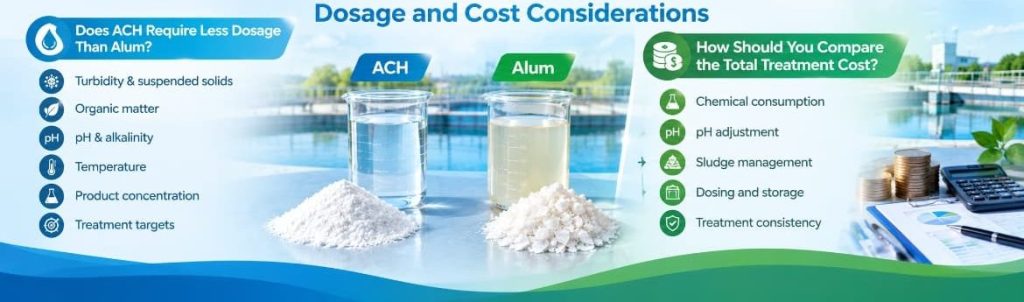
Does ACH Require Less Dosage Than Alum?
No necesariamente. ACH may achieve the required treatment performance at a lower dosage in some applications, but the result depends on the water being treated and the specifications of each product.
Several factors influence the optimum coagulant dosage:
- Turbidez y sólidos en suspensión.: Water with different particle loads may require different treatment conditions.
- Materia organica: Dissolved and natural organic matter can affect coagulant demand.
- pH and alkalinity: These influence aluminum hydrolysis and coagulation performance.
- Temperatura: Seasonal changes can affect reaction behavior and floc formation.
- Concentración del producto: Liquid and solid products may contain different amounts of active aluminum.
- Treatment targets: Clarificación del agua potable, Tratamiento de aguas residuales industriales, and other processes may require different removal efficiencies.
Por esta razón, buyers should compare ACH dosage and aluminum sulfate dosage on a clearly defined basis. Comparing kilograms of product alone can be misleading if the products have different aluminum contents or concentrations.
A jar test is a practical way to compare both coagulants. It allows operators to test different dosages and pH levels while observing turbidity removal, entrenamiento de salpicaduras, asentamiento, and pH changes.
How Should You Compare the Total Treatment Cost?
The lowest price per ton does not always mean the lowest treatment cost. When evaluating ACH cost and Alum cost, consider the complete treatment process.
- Consumo de químicos: How much product does the system need to meet its treatment target?
- ajuste de pH: Does the process require additional alkali or other chemicals?
- Sludge management: How much sludge does the process generate, and how difficult is it to handle?
- Dosing and storage: Are changes to chemical feeding, almacenamiento, or equipment necessary?
- Treatment consistency: Does the coagulant maintain reliable performance as water quality changes?
ACH may offer operational advantages when lower alkalinity consumption and reduced pH adjustment are important. Alum may remain more economical when the existing process already performs well and the chemical is readily available at a competitive price.
The best choice depends on the total cost per volume of water treated, not simply the purchase price of the coagulant.
When Should You Choose ACH or Alum?
The choice between ACH and Alum should reflect your raw water characteristics, plant design, and operating priorities.
When Should You Choose ACH?
ACH may be a suitable option when:
- Low alkalinity is a concern: Its lower alkalinity consumption may reduce the need for pH correction.
- pH stability matters: The process needs to limit the pH decrease caused by coagulation.
- Strong floc formation is a priority: The treatment system benefits from readily settleable flocs.
- Operating conditions vary: The plant needs a coagulant that performs well across its expected range of pH and temperature.
- The existing process needs optimization: Testing indicates that ACH can improve treatment performance or reduce overall operating costs.
ACH is used in tratamiento de agua potable, tratamiento de aguas residuales, and selected industrial applications. Sin embargo, buyers should confirm that the specific grade meets the requirements of the intended use, particularly for drinking water treatment.
When Should You Choose Alum?
Alum may be the better choice when:
- The existing process already works well: The plant has established dosing and pH control procedures.
- Conventional coagulation is the priority: Alum meets the required treatment targets without major process changes.
- Local supply is competitive: Availability, delivery costs, and procurement conditions favor Alum.
- The water chemistry is suitable: The system has sufficient alkalinity or can adjust pH effectively.
- The total operating cost is lower: Testing confirms that Alum provides the required performance at a competitive overall cost.
Alum remains a widely used coagulant because it is familiar to operators and suitable for many conventional water treatment processes. Replacing it with ACH should involve a performance and cost comparison rather than relying on general claims about either product.
ACH vs Alum: Which Coagulant Is Better?
Neither ACH nor Alum is universally better. Each has advantages that depend on the treatment system.
ACH may be preferable when lower alkalinity consumption, reduced pH impact, or strong floc formation offers a clear operational benefit. Alum may be more suitable when the existing system already achieves good results and its supply and operating costs remain competitive.
Before making a decision, compare the two products using the same raw water and treatment conditions. Evaluate:
- Turbidity and suspended solids removal.
- pH change and alkalinity consumption.
- Floc formation and settling performance.
- Optimum dosage and chemical consumption.
- Sludge generation and total operating cost.
A jar test provides a useful starting point for this comparison. For a full-scale plant, a controlled trial may also help confirm performance under actual operating conditions.
The goal is not simply to find the coagulant with the strongest performance in one test. It is to select a product that delivers consistent treatment results at an acceptable total cost.
Conclusión
Aluminum chlorohydrate and aluminum sulfate are both effective aluminum-based coagulants, but they behave differently in water treatment. ACH has higher basicity and generally consumes less alkalinity, which can help limit pH changes. It may also provide strong floc formation and lower sludge production in certain applications.
Alum remains a widely used, established option for conventional coagulation. It can be cost-effective when the water chemistry and existing treatment process suit its performance.
For water treatment plants, usuarios industriales, y distribuidores de productos químicos, the best choice depends on raw water quality, objetivos de tratamiento, especificaciones del producto, and total operating costs. Jar testing is the most practical way to compare ACH and Alum before making a purchasing or process decision.
Hoo Chemtec supplies water treatment chemicals, incluido Clorohidrato de aluminio (Hol), Sulfato de Aluminio (Alumbre), Cloruro de polialuminio (Pac), Cloruro férrico, and Polyacrylamide (Pam). For bulk supply inquiries, contact HOO CHEMTEC to discuss product specifications, embalaje, and your application requirements.
Preguntas frecuentes
What is the difference between aluminum chlorohydrate and aluminum sulfate?
The main difference is basicity. ACH is a high-basicity, pre-hydrolyzed aluminum coagulant that generally consumes less alkalinity than Alum. Aluminum sulfate is a conventional coagulant that can lower water pH more significantly during hydrolysis. Their actual performance depends on water chemistry and operating conditions.
Is ACH better than Alum for water treatment?
Not in every case. ACH may offer advantages when alkalinity consumption and pH control are important. Alum may be more economical for systems that already achieve effective coagulation with it. Jar testing helps determine which product performs better for a specific water source.
Does ACH consume less alkalinity than Alum?
Generalmente, Sí. ACH contains pre-neutralized aluminum species, so its hydrolysis usually consumes less alkalinity than aluminum sulfate. Sin embargo, the actual pH change and alkalinity demand depend on the product grade, dosificación, and water composition.
Does ACH produce less sludge than aluminum sulfate?
ACH may produce less sludge under certain treatment conditions, but this is not guaranteed. Sludge production depends on the coagulant dose, aluminum content, impurities in the water, y proceso de tratamiento. A controlled comparison can show whether ACH reduces sludge in a specific application.
Can ACH replace aluminum sulfate in water treatment?
ACH can replace Alum in some systems, but the change requires testing. Operators should compare dosage, ph, alcalinidad, eliminación de turbidez, floc settling, residual aluminum where relevant, y costo total de operación. They should also confirm that the ACH grade meets the requirements of the intended application.
How do you determine the dosage of ACH or Alum?
The optimum dosage depends on turbidity, sólidos suspendidos, materia orgánica, ph, alcalinidad, temperatura, and the required treatment outcome. A jar test can compare different dosages under controlled conditions. Always follow the product’s technical guidance and applicable treatment requirements.